The Hidden Bus Safety Failure That Turns Survivable Crashes Deadly
Todd Tracy investigates buses that appear sturdy but may fail when crashes turn violent. His Crash Lab traces the danger from weak standards to thin materials, poor welding, missing restraints, and glass that does not prevent ejection. The turning point is the 2014 crash involving the North Central Texas College women’s softball team, where four players died after a semi-truck struck their bus and it rolled over. Tracy shifts the question from who caused the collision to whether the bus protected its passengers. His findings point to a broader warning: schools, churches, senior groups, and travelers should question whether every bus is truly crashworthy.
A bus carries the most precious cargo on the road — children, families, church groups, sports teams, seniors, and travelers who trust that the vehicle around them will protect them in a crash.
But Todd Tracy’s Crash Lab has uncovered a disturbing truth hidden beneath the yellow paint, bold graphics, tinted windows, and high-backed seats.
Manufacturers build some buses to safety standards so weak, and with structural materials so flimsy, that passengers are left exposed when the vehicle rolls over, is struck from the side, or tears apart in a violent impact.
Not All Buses Are Built Alike
The result is a public-safety failure hiding in plain sight. Crashes that should be survivable become death traps.
Tracy says the danger begins with a fact most passengers never learn until tragedy strikes: buses that look alike may not be built, tested, or regulated the same way.
A vehicle may look like a school bus, operate like a school bus, or carry children like a school bus. But depending on its weight, classification, and use, it may be governed by a different set of safety standards than the yellow bus parents assume is protecting their child.
Motor coaches, school buses, shuttle buses, and smaller buses can fall under different rules, even when they are carrying the same kind of passengers on the same highways.
That distinction can decide whether a bus is built with stronger materials, whether it has glass designed to reduce ejections, and whether passengers have lap-and-shoulder belts to keep them in their seats during side impacts and rollovers.
Equal Passengers. Unequal Protection.
In the video, Tracy delivers a blunt warning to parents, schools, churches, universities, senior groups, and travelers: not all buses are created equal.
But the people riding inside them should be protected equally.
Passengers who should walk away instead suffer catastrophic brain injuries, spinal cord damage, amputations, paralysis, burns, or death.
Todd Tracy’s Questions Parents Should Ask Before A Child Rides A Charter Bus Or School Bus
Parents should not assume that a bus is safe because it is big, yellow, new-looking, or operated by a school, church, university, sports team, camp, or tour company. Before a child boards, parents should ask direct questions.
1. Does every passenger seat have a lap-and-shoulder belt?
Do not settle for “the bus meets federal standards.” Ask whether the specific bus your child will ride has lap-and-shoulder belts at every seating position.
2. Will students be required to wear the seat belts?
A bus equipped with belts is not enough. Ask whether adults, coaches, teachers, or chaperones will make sure every child buckles up and stays buckled during the trip.
3. What type of bus will be used?
Ask whether it is a full-size school bus, motor coach, shuttle bus, mid-size bus, church bus, activity bus, or 15-passenger van. Different vehicles may be built and regulated under different safety standards.
4. What year, make, and model is the bus?
Parents should know exactly what vehicle is carrying their child. Older buses may lack modern occupant protection, better glazing, stronger structures, electronic stability control, or improved restraint systems.
5. Has the bus ever been in a crash or rebuilt after major damage?
Ask for written confirmation. A bus that has been repaired after a serious collision may have hidden structural weaknesses if the repairs were not performed correctly.
6. Has the bus passed a recent safety inspection?
Ask when the bus was last inspected, who inspected it, and whether any defects were found. A vague answer is not good enough.
7. How old are the tires?
Tires can look acceptable from the outside and still be dangerously aged, damaged, underinflated, or poorly maintained. Ask when the tires were manufactured, when they were last inspected, and whether the company checks tire pressure before each trip.
8. Does the company use tire-pressure monitoring?
A fully loaded bus places enormous stress on its tires. Underinflated tires can overheat and fail, especially on long highway trips.
9. Has the driver been screened, licensed, and trained for this specific kind of trip?
Ask whether the driver has the proper commercial license, passenger endorsement, medical clearance, background check, and training for highway, night, mountain, winter, or long-distance driving.
10. How many hours will the driver be on duty?
Fatigue can be deadly. Ask when the driver’s shift begins, how long the trip will last, whether the driver had adequate rest, and whether a relief driver is required.
11. Will the trip involve overnight driving?
Overnight bus travel raises the risk of fatigue. Parents should ask whether the schedule can be changed to avoid late-night or early-morning highway travel.
12. Does the bus have electronic stability control?
Electronic stability control can help reduce loss-of-control and rollover risk, especially in larger passenger vehicles and buses.
13. What kind of window glass does the bus use?
Ask whether the side windows are designed to help reduce ejection. Tempered glass may shatter in a crash. Laminated or ejection-mitigation glass can help keep occupants inside the vehicle.
14. Has this bus been crash-tested for side impacts and rollovers?
Parents should ask whether the bus design has been tested for the kinds of crashes that cause catastrophic injuries — not just whether it complies with minimum rules.
15. What is the emergency evacuation plan?
Ask how students will get out if the bus rolls over, catches fire, or doors and windows are blocked. Ask whether chaperones know how to open emergency exits.
16. How many adult chaperones will ride on the bus?
Children need supervision before and during the trip. Chaperones should make sure students remain seated, belted, and calm.
17. Will luggage, band equipment, sports gear, or coolers be secured?
Loose equipment can become dangerous in a crash, sudden stop, or rollover. Ask how cargo will be restrained.
18. What is the carrier’s safety record?
For charter buses, ask for the company’s legal name and U.S. DOT number. Parents or school officials should check the carrier’s safety record before signing a contract.
19. Who is responsible for approving the bus company?
Parents should ask whether the school district, coach, booster club, church, university, or tour organizer selected the carrier — and what safety criteria were used.
20. Would you put your own child on this bus?
That is the final question parents should ask school officials, coaches, church leaders, and bus operators. If they hesitate, parents should hesitate too.
When Size Becomes A Deadly Illusion
A bus may look massive. It may look safe. But Tracy’s investigations show that size can create a deadly illusion.
In the video below, Tracy analyzes the wreckage of a bus involved in a crash that killed four members of a women’s college softball team.
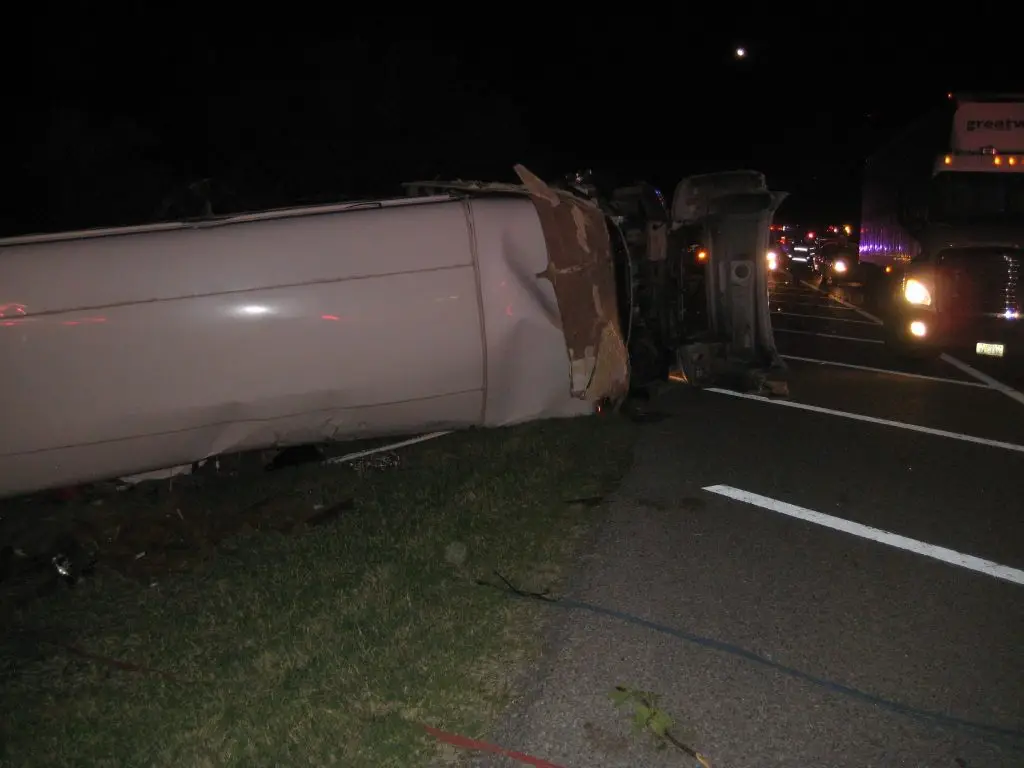
The vehicle was sideswiped and rolled over, spilling young lives into the highway.
To the public, it may have looked like a tragic highway collision.
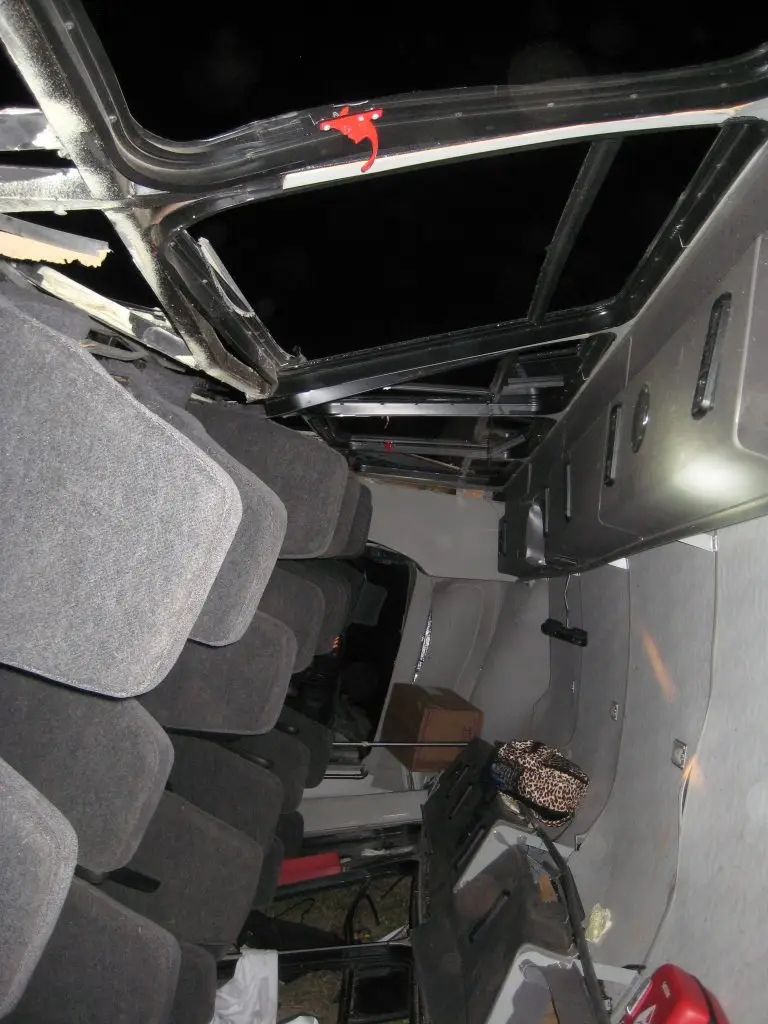
To Tracy, it was something more disturbing: a case study in weak design, flimsy construction, poor welding, and the absence of real-world crash testing.
Built Like Lawn Furniture
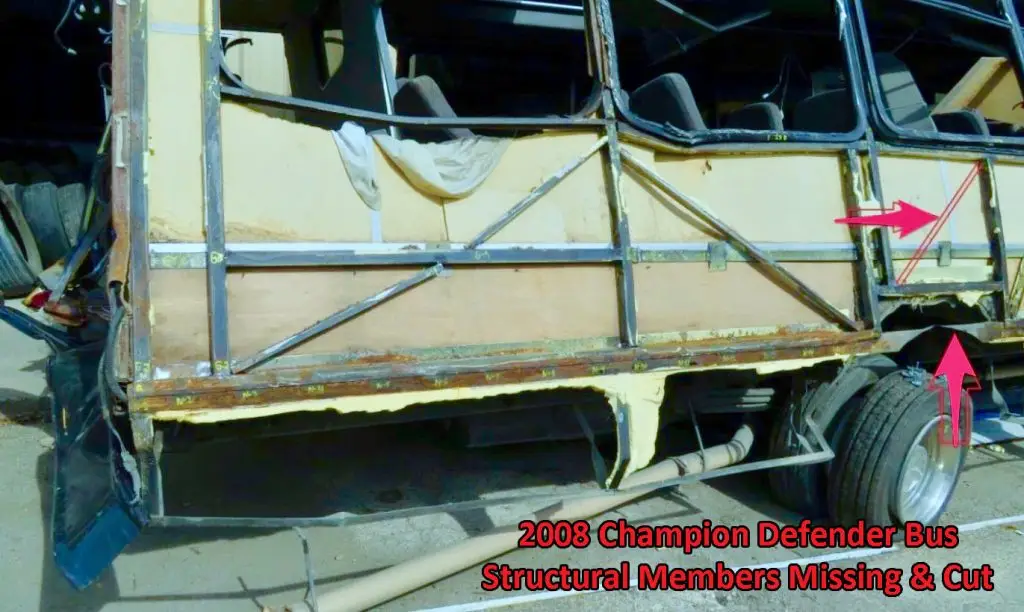
He points to the material used inside the bus structure – one-and-a-half-inch square tubing that he says was more suitable for lawn furniture than for protecting passengers in a highway crash.
He holds up foam from the bus and pieces of thin wood veneer panels.
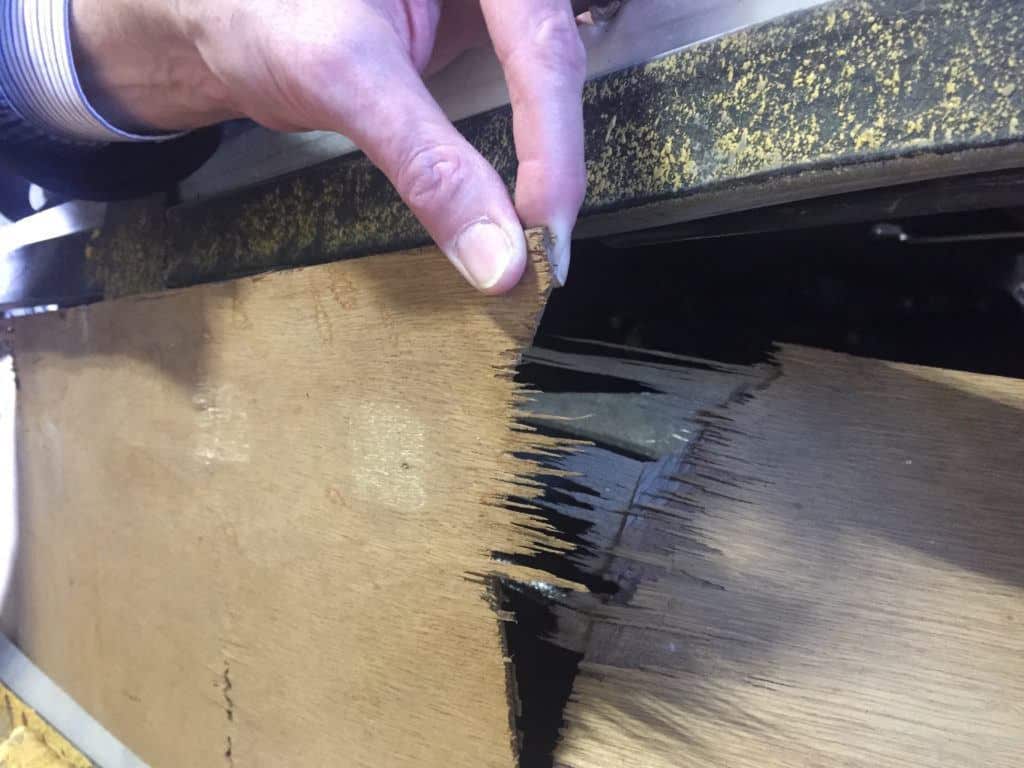
Building contractors commonly use the skinny wood paneling for decoration.
According to Tracy, it is the equivalent of using “kindling,” the small dry pieces of wood used to start a fire, inside your car door instead of sheet metal.
Missing Welds
Tracy’s investigation revealed a failure hidden inside the bus’s wall: sections of the thin metal tubing that formed the side structure were not properly welded, leaving the passenger compartment vulnerable when the crash forces hit.
Tracy found that some sections of tubing were attached at only one corner, rather than welded on all four sides, creating weak joints in the very frame that was supposed to protect passengers.
For Tracy, those failures added up to what he called a “recipe for disaster.”
His lesson is blunt. When manufacturers do not engineer, manufacture, and test buses as if lives are at stake, people die.
In this crash, four young women died in the prime of their lives.
A Collision Is Not The Whole Story
When the bus structure fails, the seats fail, the roof crushes, or passengers fly out of their seats, the promise of safe transportation can collapse in seconds.
The warnings from Tracy’s Crash Lab are not abstract engineering complaints.
Wreckage, lawsuits, funerals, and empty seats on a college softball roster tell a tragic story.
The Women’s Softball Team Crash
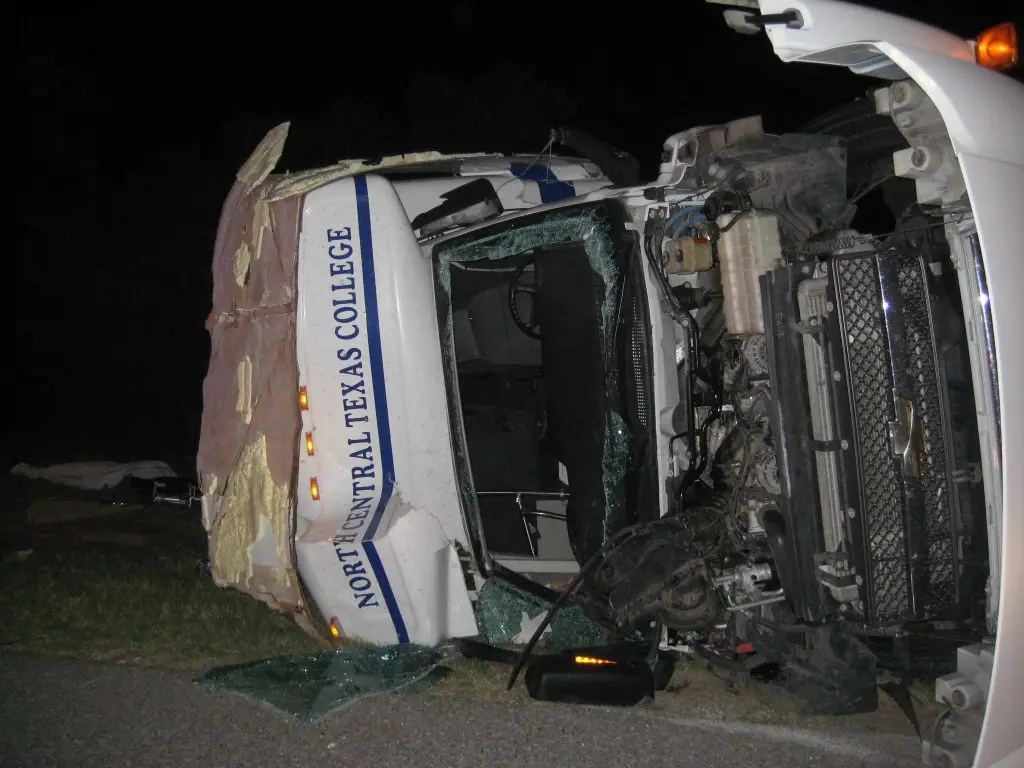
The crash described above occurred on September 26, 2014, when an 18-wheel semi-truck crossed the median of Interstate 35 and sideswiped the bus carrying the North Central Texas College women’s softball team.

Four of the 15 players on the bus suffered fatal injuries when the bus rolled over and ejected them.
The victims included 20-year-old Brooke Deckard of Blue Ridge, Texas; 20-year-old Jaiden Pelton of Telephone, Texas; 19-year-old Meagan Richardson of Wylie, Texas; and 18-year-old Katelynn Woodlee of Dodd City, Texas.
Out of the eleven survivors, 5 sustained serious injuries and six received minor injuries.
A trip that should have ended with players walking off a bus instead ended with families identifying daughters who never came home.
Who Caused The Deaths?
Investigators from the National Transportation Safety Board (NTSB) found a silver marijuana pipe and a bag of synthetic drugs in the cab of the truck.
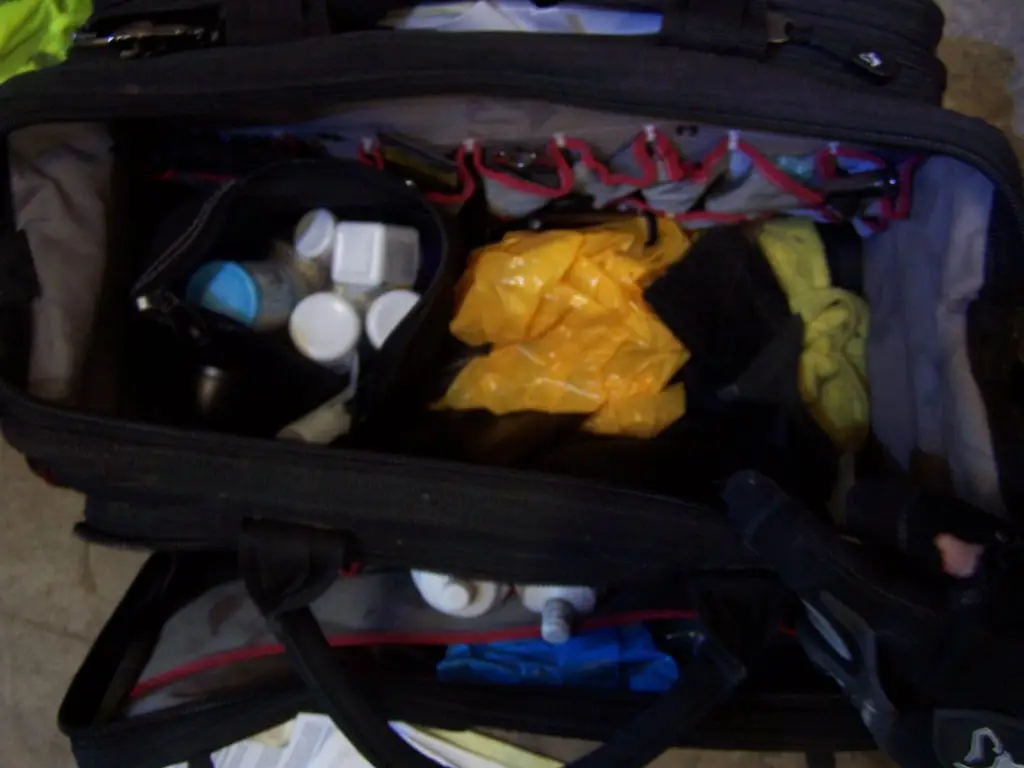
They concluded that the semi-truck driver, 55-year-old Russell Staley, was under the influence of synthetic marijuana, known as K2, and documented his history of drug abuse.
Staley died of a self-inflicted gunshot shortly before facing trial on four first-degree manslaughter charges.
Everyone knew who caused the collision.
But Todd Tracy asked the question that often exposes the deeper failure in catastrophic crash cases: Who caused the deaths and life-changing injuries?
Tracy’s Investigation Focused On The Bus
His investigation shifted the focus from the impact itself to the 2008 Champion Defender 32-passenger medium-size bus that was carrying the 15-member team home to Gainesville, Texas, from a game in Oklahoma.
In Tracy’s view, this was a survivable crash that became a death case because the bus failed to minimize injuries or death following an accident.
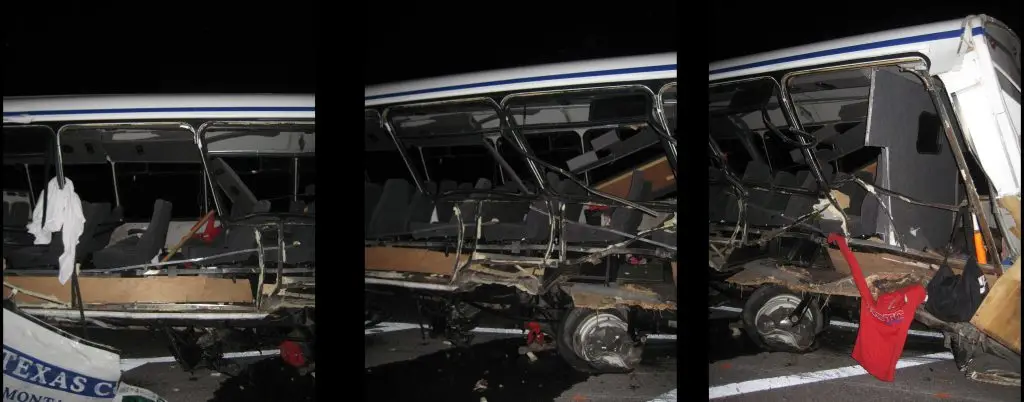
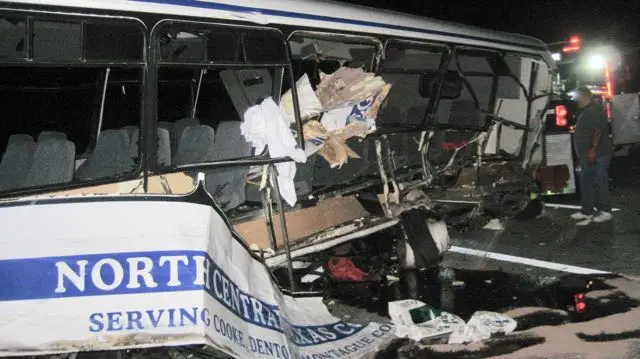
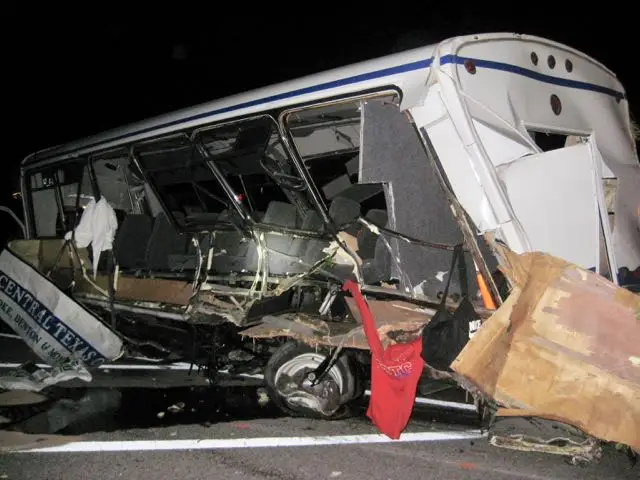
The sideswipe peeled open the bus’s driver’s side like a tin can, leaving the players vulnerable inside a shell that should have protected them.
Tracy and his team of automotive engineers found the hidden failure behind the horror.
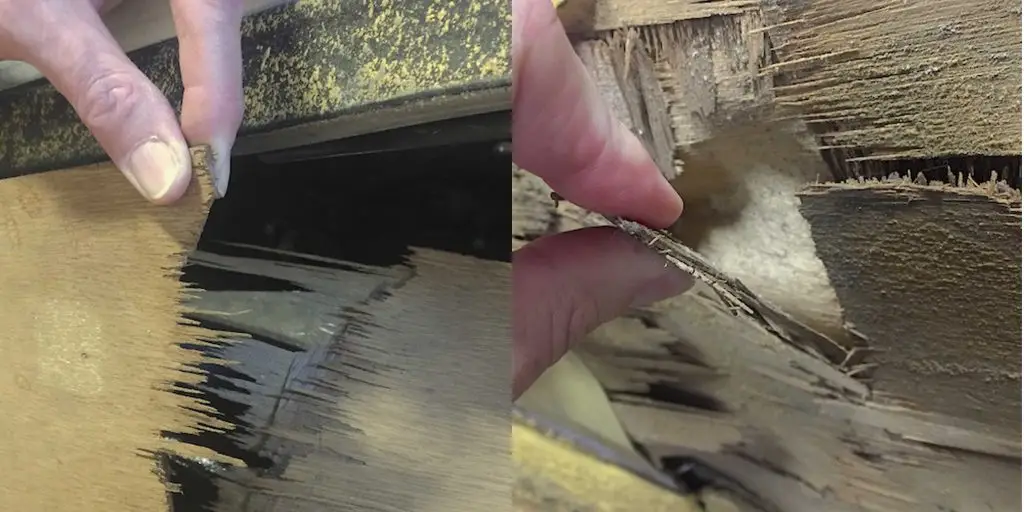
Inside the side wall of the bus, Tracy’s team found what he described as a shocking substitute for real crash protection: thin wood veneer panels used in home remodeling, foam, and thin metal tubing, like the kind used in cheap lawn furniture.
Families Shocked By Evidence Of Shoddy Construction
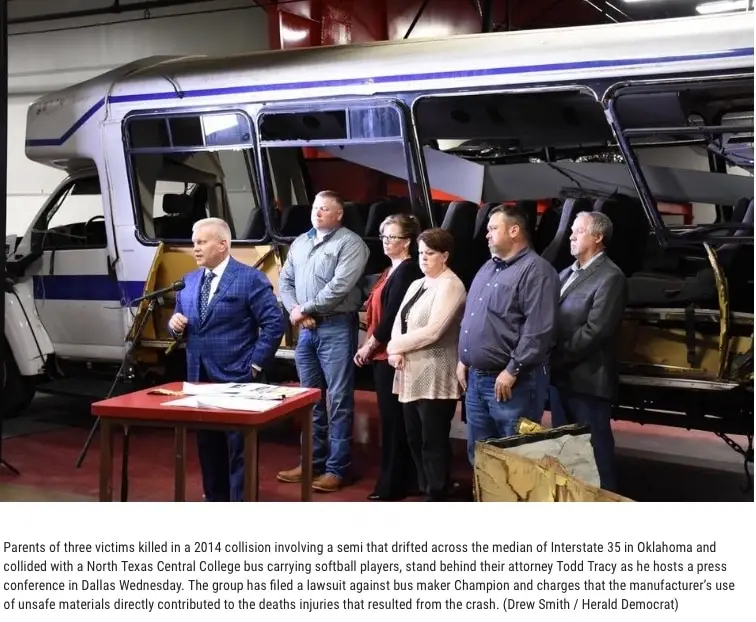
Tracy filed a product liability and negligence lawsuit against Champion Bus on behalf of the families of three victims.
The lawsuit brought the victims’ families face-to-face with the bus their daughters had trusted.
In the television news report shown below, the parents walked into Tracy’s Crash Lab and saw the hidden danger beneath the vehicle’s thin outer skin.
They saw the foam. They saw the wood veneer paneling. They saw the lawn chair-style structure.
They saw the open side of the bus where the crash had ejected their daughters.
For the families, the wreckage answered a question no parent should ever have to ask after a crash: What was my child really riding in?
What Crashworthiness Means
It was a classic crashworthiness case. Tracy’s engineers concluded that Champion failed to meet these principles in the design of the bus.
Crashworthiness is the science of minimizing the risk of serious injury and fatality in motor vehicles, following an accident, through the use of safety systems.
There are five basic crashworthiness principles:
- Maintain occupant survival space
- Manage the kinetic and potential energies
- Restrain the occupant
- Prevent ejection
- Prevent fuel-fed fires
The Five Failures
Tracy’s Crash Lab analysis found that Ms. Woodlee, Ms. Pelton, and Ms. Richardson would have had minimal injuries and certainly no fatal injuries, absent the failure of the structure and/or restraint systems, because:
- The vehicle’s survival space was severely compromised.
- The roof crush is similar to that in a typical bus rollover.
- The vehicle did not manage the energy very well, and as a result, the suspension was damaged, causing the vehicle to overturn.
- The structure collapsed, and the window frames were damaged, preventing an easy escape. The restraint systems were not available for use, and the absence of window glazing failed to keep the occupants from being ejected.
One Settlement. A Larger Warning
Champion Bus ranks among the largest custom mid-size commercial bus manufacturers in the United States.
It produces more than 1,500 mid-size buses per year out of its 194,000-square-foot manufacturing facility in Imlay City, Michigan.
Confronted with Tracy’s evidence, Champion Bus reached an out-of-court settlement with the three victims’ families that he represented.
Tracy believes the problem extends far beyond one wrecked bus. In his view, thousands of similar buses built by other manufacturers may fail the basic test of crashworthiness when passengers need protection most.
Illusion of Safety
Parents put children on buses for band trips and athletic events. Churches use smaller buses and passenger vans for retreats. Senior centers, hotels, casinos, airports, universities, sports teams, and tour operators rely on them every day.
They may look substantial from the outside, but they were never engineered, built, or tested to withstand the kinds of crashes that occur on American highways.
For Tracy, the lesson from the deadly softball team bus does not end with one manufacturer, one crash, or one lawsuit.
It opens a larger question about the buses Americans trust every day.
School Bus Danger
Unbelievably and sadly, vehicle crashworthiness principles have not been applied to school buses as vigorously as they have to airplanes, helicopters, racing cars, or passenger vehicles.
This defies common sense, since millions of children ride school buses each day to and from school and to various school-sponsored events.
The United States school bus system is the largest mass transportation system in the world.
The national fleet consists of more than half a million buses, and they travel billions of miles per year.
However, most American school buses do not contain seat belts, lack glass that helps prevent ejection risks, have inadequate structural integrity to provide adequate protection in frontal, side, and rollover accidents, and lack post-crash fire protection features.
How Safe Is The Big Yellow Bus?
The next time your child gets on that big yellow school bus, ask yourself this question:
*How safe is my child’s school bus in the event of an accident?*
The answer is simple: buses that transport our children will not protect them in a serious accident because buses are not crashworthy and fail to use available, affordable occupant protection systems.
The Limits Of Compartmentalization
In his school bus safety warning, Tracy says parents often put children on buses without knowing whether the vehicle has lap-and-shoulder belts or whether its safety systems can protect them in the crashes that matter most.
Compartmentalization, the padded, energy-absorbing zone created to replace lap and shoulder belt restraints, may help in a frontal impact.
But Tracy warns in this video that it offers little protection when a bus is struck from the side or rolls over.
Look Beyond The Driver And The School District
Tracy says the focus must move beyond the driver and beyond the school district.
Bus manufacturers, he argues, know how their vehicles perform and how they fail — in frontal impacts, side impacts, rear impacts, and rollovers.
In his view, regulations should require manufacturers to conduct rigorous crash testing and provide the strongest available restraint systems.
Because at the end of the day, Tracy says, the people riding in those buses are children — “our most precious cargo.”
How School Buses Got Here
In 1837, horse-drawn carriages called school hacks, school trucks, or kid hacks carried children to school. These were often nothing more than wagons or sleds.
By 1914, a wooden kid hack was placed onto an automobile chassis that was horse-drawn. Ingress and egress were through a door at the rear so the horses would not be startled.
In 1927, the first all-steel school bus was built. It contained steel stretched over wood with canvas for windows.
The Birth Of School Bus Yellow
In April 1939, Dr. Frank W. Cyr organized a conference at Teachers College, funded by a grant from the Rockefeller Foundation for transportation. Officials from each of the then 48 states, as well as specialists from school bus manufacturing and paint companies, attended the conference.
Engineers from Blue Bird Body Co., Chevrolet, International Harvester, Dodge, and Ford Motor Company, as well as paint experts from DuPont and Pittsburgh Paint attended.
Together with the transportation administrators, they met for seven days and agreed on 44 standards, including the bus color and some mechanical specifications such as body length, ceiling height, and aisle width for school buses.
The lasting standard from this conference is the familiar yellow school bus design and paint scheme. Dr. Cyr chose the “school bus yellow” with black lettering paint scheme because it was easy to see in the early morning and late afternoon.
Safety Standards Frozen In Time
For the next 30 years, virtually no safety advances were made in school bus safety, even though researchers in the 1960’s were demonstrating that safety improvements were needed to better protect children in frontal, side, rear, and rollover accidents.
In 1974, Congress determined that “school transportation should be held to the highest level of safety, since such transportation involves the nation’s most precious cargo—the children who represent our future.” These amendments finally came in 1977, when the NHTSA adopted school bus safety standards.
The 1977 school bus safety standards have never been revised, even though attempts have been made to improve the crashworthiness of school bus safety to keep up with improved occupant protection technology.
Each of these efforts to improve school bus safety has been resisted by the school bus manufacturing industry as well as others.
In July 2007, the NHTSA heard oral statements on proposals to make school buses safer by enacting regulations that have been requested since the 1960’s. The formal comments ended January 22, 2008.
It could be years before any safety rules are finally adopted, since it took 10 years from the 1967 UCLA study to final rule making on the last set of inadequate school bus standards.
Four Types of School Buses
The school bus industry defines four types of school buses.
Yet, school buses are constructed very differently. As such, many of the standard rescue tools may not work on certain parts of all buses.
This fact alone justifies uniformity in design. However, designs among school buses are not uniform. This must change!
- The Type A school bus consists of a bus body constructed upon a cutaway front-section vehicle with a left side driver’s door, designed for carrying more than 10 persons. This definition includes two classifications: Type A-I, with a gross vehicle weight rating (GVWR) of 10,000 pounds or less, and a Type A-2, with a GVWR of 10,000 pounds or more. Type A school buses meet all Federal Motor Vehicle Safety Standards for school buses.
- The Type B school bus consists of a bus body constructed and installed upon a front-section vehicle chassis, or stripped chassis. Type B-1 buses have a gross vehicle weight rating less than 10,000 pounds. Type B-2 buses have a gross vehicle weight rating of more than 10,000 pounds. Part of the engine is beneath and/or behind the windshield and beside the driver’s seat. The entrance door is behind the front wheels. Type B school buses meet all Federal Motor Vehicle Safety Standards for school buses.
- The Type C school bus, also known as a “conventional,” is a body installed upon a flat-back cowl chassis with a gross vehicle weight rating of more than 10,000 pounds, designed for carrying more than 10 persons. All of the engine is in front of the windshield and the entrance door is behind the front wheels. Type C school buses meet all Federal Motor Vehicle Safety Standards for school buses.
- The Type D school bus, also known as a “transit-style,” is a body installed upon a chassis, with the engine mounted in the front, midship, or rear with a gross vehicle weight rating of more than 10,000 pounds, and designed for carrying more than 10 persons. The engine may be behind the windshield and beside the driver’s seat; it may be at the rear of the bus, behind the rear wheels; or midship between the front and rear axles. The entrance door is ahead of the front wheels. Type D school buses meet all Federal Motor Vehicle Safety Standards for school buses.
Type I And Type II: The Seat Belt Divide
Federal Motor Vehicle Safety Standards are not the same for all four types of buses.
If a bus is considered Type I, it has a gross vehicle weight rating of over 10,000 pounds which are Type C and D buses. No seat belts are required on Type I buses.
Type II buses have a gross vehicle weight rating under 10,000 pounds, thus may be either Type A-1 or B-1 buses. Seat belts are required on all Type II buses.
Of the 482,000 school buses in the United States, 85% are Type I buses which are not required to have a seat belt. Hence, 20,485,000 children (409,700 buses x 50 children) are exposed each day to injuries and death risks that could be prevented simply by adding seat belts.
The UCLA Warning
School bus safety should focus on one thing: How well does a bus protect our children during an accident?
The federal government commissioned UCLA to conduct bus crash testing in 1967 because the “number of injuries and the number of fatalities was considered too high.” UCLA found that poor seat design was a major contributor to injuries and fatalities. The UCLA study reached the following conclusions:
- Seat backs should be 28 ” high and well padded.
- Left and right interior side panels should be well padded.
- A well padded aisle panel should be installed.
- Lap belts were suggested to keep children within the seating “compartment.”
Federal Standards That Fall Short
Armed with UCLA’s bus safety results, it still took 10 years for the NHTSA to promulgate school bus safety standards. However, the standards were inadequate.
For example, FMVSS 222, the most significant of the new bus standards, fell way short of the UCLA recommendations. Seat backs were 8” shorter than recommended, there were no provisions for left and right side padding, no aisle panels were defined, and no lap belt restraints were required.
Now the NHTSA proclaims that there are 38 FMVSS provisions that apply to school buses.
However, much like their vehicle counterparts, these provisions are inadequate to protect children in the event of an accident.
How so? They are outdated. They are inept. They are minimal. They fail to evaluate a dynamic event like a crash. They are unrealistic in their application.
Standards That Do Not Crash Test The Crash
Below is a sampling of the FMVSS regulations that are unique to school buses.
- FMVSS No. 217, “Window Retention and Release”
- FMVSS No. 220, “School Bus Rollover Protection,” which specifies the minimum structural strength of buses in rollover-type accidents;
- FMVSS No. 221, “School Bus Body Joint Strength,” which specifies the minimum strength of the joints between panels that comprise the bus body and the body structure;
- FMVSS No. 222, “School Bus Passenger Seating and Crash Protection,” which establishes requirements for school bus seating systems for all sizes of school buses, and provides minimum performance requirements for wheelchair securement/occupant restraint devices and establishes a requirement that wheelchair locations be forward facing; and
- FMVSS No. 131, “School Bus Pedestrian Safety Devices,” which requires school buses be equipped with an automatic stop signal arm on the left side of the bus to help alert motorists that they should stop their vehicles because children are boarding or leaving a stopped school bus.
Each of these provisions sounds like adequate protection, but when each standard is analyzed individually, children are at risk.
For example,
- FMVSS 217 does not require the use of laminated glass, which can help prevent ejection. This type of glass is critical because most buses lack seat belts.
- FMVSS 220 has no requirement to test the strength of a roof under rolling or dynamic conditions.
- FMVSS 221 and 222 do not require a crash test. In short, the federal school bus standards fail to protect children.
In short, the federal school bus standards fail to protect children.
The Injury Numbers No One Wants To Count
According to the Transportation Research Institute, school buses are involved in more fatal crashes than transit, inter-city, or charter buses combined.
Yet one of the primary arguments opponents of improving school bus safety make is the low number of school bus fatalities.
In fact, one of the primary culprits of this flawed position has been the NHTSA. For years, the NHTSA has reported that there were only 74 deaths involving students on school buses between 1995 and 2005.
However, the NHTSA fails to accurately report the number of serious injuries to children on school buses.
The NHTSA also fails to discuss the medical costs incurred due to these injuries, the lost time from work that the injured student’s parents endure, or the lost time from school that the injured student experiences.
Each of these is a critical statistical event that has not been considered.
The American Academy of Pediatrics reported in its November 2006 issue that 17,033 children are injured each year in school bus accidents.
The study concluded that three times as many school bus injuries were occurring as had ever been reported by the NHTSA.
Of these hospitalizations, 1,200 involved traumatic brain injury. The authors of the study concluded that seat belts would have prevented the vast majority of these injuries.
In Texas alone, there are seven fatalities and 857 injuries to school children each year in school bus accidents.
NHTSA’s presentation of the Journal of Pediatrics findings underreports the number of school bus injuries by 63%.
The Beaumont, Texas Soccer Team Rollover
What these statistics do not show is the long-term consequences and costs associated with a school bus accident.
This point can be demonstrated by studying a tragedy involving the Westbrook High School soccer team in Beaumont, Texas, whose charter bus rolled over on March 29, 2006. In the accident, Ashley Brown and Alicia Bonura died.
The two other girls were pinned under the bus for over an hour. One player had her arm amputated, and another had permanent disability of an arm and hand. Another suffered extensive facial disfigurement.
Combined, this soccer team endured 17 surgeries, eight months of lost school instructional days, hundreds of hours of physical therapy, millions of dollars of medical expenses, and the horror continues because the medical costs continue to increase. The psychological scars of these children may never heal.
The charter bus they were on had no seat belts and glass that failed to mitigate against ejection. If these girls had been restrained by lap and shoulder belts the injuries and deaths most likely would have been avoided.
Why Seat Belts Matter
Even though slogans like “Buckle Up, It’s The law”; “Buckle Up For Safety”; “Don’t Be A Dummy, Buckle Up”; and “Click it, or Ticket” have been around for years, these slogans do not apply to school buses.
In 47 states, there are mandatory seat belt laws for children, but these laws do not apply to school buses. How confusing is this for our children?
You can receive a ticket for not buckling your seat belt in their parents’ vehicle. However, police cannot issue tickets to students on school buses.
Why not? Because 85% of our nation’s school buses lack seat belts. This simply defies logic, since engineers and physicians. and crash safety experts all agree that seat belts in vehicles save lives and minimize injuries.
The American Automobile Association has written that “restrained occupants are more likely to escape harm by spreading the force of impact and gradually stopping the body, safety belts effectively reduce the severity of injuries.”
The NHTSA and NTSB must agree since seat belts are mandatory in all vehicles. The FAA and NTSB must agree that seat belts on aircraft save lives and prevent injuries since you are required to wear a seat belt during takeoff, landings, and turbulent air.
However, the occupant protection value of seat belts on school buses has been debated for decades.
The Debate Over Restraints
Advocates for school bus seat belts contend that seat belts would reduce injuries by keeping children within their seating compartment in side impacts, evasive maneuvers, and rollovers. Advocates also note that a restrained occupant will improve student behavior and reduce distractions to drivers.
The American Medical Association has proposed seat belts on school buses, American Academy of Pediatrics, the American Association of Orthopedic Surgeons, the American College of Preventive Medicine, Physicians for Automotive Safety, the National Coalition for School Bus Safety, and the National PTA. European Union countries and Australia have required lap/shoulder belts in school buses for over a decade.
Opponents of requiring seat belts on large school buses contend that studies show adding seat belts is not a cost-effective safety improvement relative to the safety principle known as compartmentalization.
Opponents note that studies have shown that seat belts might save one life and several serious injuries each year, at an annual cost of hundreds of millions of dollars.
They also contend that adding seat belts decreases seating space and would displace some children, forcing additional bus purchases.
They have also suggested that children may not use seat belts on school buses.
The National Association of State Directors of Pupil Transportation Services, the National School Transportation Association, and bus manufacturers have led the lobbying effort against seat belts on school buses.
Seat Belts Rejected
Persuaded by opponents of school seat belts, the NHTSA decided in 1976 that seat belts were not required on larger school buses.
Instead, occupant protection would be provided by compartmentalization, which refers to a system that protects unrestrained passengers by using high-backed, well-padded, and well-anchored seats designed to absorb energy from frontal impacts, placed in relatively closely spaced rows.
Compartmentalization can be potentially beneficial in frontal impacts if the seat is properly padded, high-backed, and allows the unrestrained occupant to ride down the crash forces.
Testing by the NHTSA in 2001 using 28” high, well-padded seats which were properly anchored to the floor, adequately protected children in frontal impacts. However, most school bus seats are not properly padded and are not adequately reinforced to the floor. Further, most bus seat backs are only 20 inches tall. The 20-inch bus seat allows the striking occupant to override its head or torso over the top of the struck seat back.
Compartmentalization provides no safety protection in side impacts, as seen during NHTSA’s sled test program. However, seat belts do protect against side impacts and rollovers, according to the NTSB’s accident simulations.
What Compartmentalization Cannot Do
Compartmentalization offers no protection to students who are out of position because the driver has swerved or the student bounces off the seat when the bus hits a bump. The NHTSA finally concluded in 2002 that “compartmentalization fails to provide adequate protection in rollover and side impacts, which account for one-third of all accidents.” They failed to mention out-of-position children. The NHTSA’s conclusion is three decades too late.
Testing by UCLA researchers in 1967 revealed that seat belts on buses increased safety. In 1986, the NHTSA reported that student behavior improved on buses equipped with seat belts.
Opponents of school bus seat belts argue that children will not wear a seatbelt on school buses. They forget that children of this generation have grown up using seat belts.
The importance of wearing a seat belt is preached to children by caregivers each day. Children often remind their own parents to buckle up.
In 1987, the National Academy of Sciences found that seat belts would reduce fatalities by 20 percent and serious injuries by 40 percent.
In 1989, the Transportation Research Board determined that seat belts would prevent one fatality and minimize several dozen serious injuries each year. However, the study concluded that a federal mandate requiring school bus installation was unnecessary. In 1999, the NTSB found that compartmentalization was an incomplete occupant protection system.
In fact, the NTSB found that the “potential exists for an occupant protection system to be developed that would protect school bus passengers by retaining them with the seating compartment in most accident scenarios.” The NTSB directed the NHTSA to develop standards that protect passengers in all directions of travel, including rollovers. A 2002 NHTSA study found that lap/shoulder belts have the potential to reduce fatalities and injuries in non-frontal crashes.
Despite overwhelming safety data, only six states currently require seat belts on new buses. (California, Florida, Louisiana, New Jersey, New York, and Texas). In hearings before the NHTSA in July 2007 regarding seat belts on school buses, the school bus industry spokesman testified that only 2% of America’s school buses were equipped with lap-and-shoulder belts.
Preventing Ejection
The NHTSA has determined that there is a 13 times greater chance of serious injury if an occupant is ejected during an accident. Lap/shoulder belts will help prevent complete ejection, but they cannot prevent partial ejection.
Partial ejection through window openings has been addressed in passenger vehicles with rollover airbag curtains and side-impact airbag curtains, after the window glazing proposed rulemaking change was defeated, which would have required ejection-mitigation glass. However, no such ejection-mitigation airbags are installed on school buses.
To prevent or minimize the risk of partial ejection through a school bus window, bus manufacturers should use ejection-mitigation glass rather than tempered glass.
Ejection-mitigation glass is commonly referred to as laminated, plastic, or bilayer glass. Ejection-mitigation glass is far less likely to shatter in a crash than tempered glass and is therefore more likely to prevent passengers from being ejected from the bus.
There is no federal standard mandating the use of ejection-mitigation glass on school buses. As such, school bus manufacturers continue to use tempered side glass rather than the safer ejection mitigation glass.
Opponents of improved school bus glass may argue that ejection is rare. In 1999, the NTSB wrote that FARS (fatal accident reporting service) data is not a reliable source for identifying the number of fatal occupant ejections in buses. Rather than improve data retrieval methods to determine how prevalent the ejection problem is in school bus crashes, nothing was done.
Ejection is a Prevalent Issue
On December 1, 2004, the NTSB released its “Most Wanted” transportation improvement devices to better protect bus passengers from being ejected. To date, no standard has been proposed that requires ejection-mitigation glass on school buses, including the latest bus changes proposed in 2007. Ejection mitigation glass used on vehicles today has proven effective in protecting against ejections.
ETG (enhanced technology glass) is an advanced glazing system that incorporates the Safeflex K series high-security interlayer, derived from PPG’s experience with hurricane impact glazing technology, which provides increased tear strength and penetration resistance during 150 mph wind tests.
Vehicle glazing has evolved from its original task of keeping bugs out of our teeth to the multi-functionality of Enhanced Technology Glass, which protects against ejection.
According to General Motors, “all 12 and 15 passenger vans have Enhanced Technology Glass to help protect passengers during a crash. This specialty glass is located in the rearmost side window positions next to the fourth- and fifth-row passengers. The glass is designed to help mitigate the risk of ejection for passengers seated next to the ETG windows who do not have the benefit of side curtain airbags.”
If this glass is safe enough for 12/15 passenger vans, it would be safe in Type I school buses and should be used immediately as a much-needed safety feature.
Maintaining The Survival Space
On August 31, 2007, the Congressional Research Service reported that large school buses have energy-absorbing front-end designs.
These authors must not have reviewed the crash tests where the entire front structure of a Type C bus crushed into the bus’s survival space. There was no controlled crush like is seen when a properly designed vehicle is evaluated under the same test.
But Tracy argues that the conclusion collapses when measured against actual crash tests where the entire front structure of a Type C bus crushed into the bus’s survival space.
That amount of crush would never be deemed acceptable in a passenger vehicle.
The authors of the Congressional report also wrote that schoolchildren are protected because they are positioned above the level of most other vehicles on the road, which protects from side-impact crashes.
Sadly, they must not have reviewed the side-impact tests in which school buses were literally torn apart.
The authors also failed to consider that the NHTSA has never conducted a single rollover test to evaluate the occupant protection capabilities of school buses. Roof testing by American bus manufacturers has revealed that bus roof structures are incapable of protecting the survival space during a rollover.
Had these authors searched more deeply, they would have found records dating back to the 1940’s, in which school bus designers always feared that the points where panels and pieces were fastened together, called joints, were prone to structural failure.
In 1967, the Ward Body Company subjected one of its school bus bodies to a rollover test and noted separation at the joints due to rivet, screw, and huckbolt (fastener) failures.
Other tests revealed that simply increasing the number, size, and quality of fasteners did not prevent joint separation. As a result, designers created continuous longitudinal interior and exterior panels for sides and roofs.
This design, called the Lifeguard design, reduced overall body weight, the number of fasteners used, and man-hours for assembly. However, the Lifeguard design required very large roll-form presses and special equipment to handle the panels. Also, the panels had to be cut to the exact length for each bus order, which created marketing difficulties. After 1973, the Lifeguard design was not widely used by the bus manufacturers.
Managing Crash Energy
One of the ways a crashworthy vehicle provides occupant protection is by controlling the energy transmitted into the survival space.
For years, the school bus industry argued that the size of the school bus offered a greater degree of protection from injury because a bus is so large that it will absorb energy and the children will not be hurt.
This position actually violates Newtonian physics. If a vehicle weighs 3,000 pounds or 24,000 pounds (the weight of a large school bus) and experiences a delta velocity of 30 mph, the unrestrained objects inside both vehicles experience the same delta velocity, no matter the weight of the object.
Amazingly, though, the NHTSA stated as late as October 2007 that, because school buses are larger and heavier than their impacting partners, lower crash forces will be imparted on bus occupants.
This is technically accurate in that lower G’s will be experienced on the bus, but delta velocity is what causes the injury. The delta velocity is the same regardless of weight.
Inadequate Testing
School buses are not tested with in-vehicle test devices to evaluate loads on the body. Further, no dynamic test standards exist to evaluate the types of loads experienced inside the survival space following frontal, side, rear, and rollover tests on instrumented dummies.
Testing conducted by manufacturers has shown that the structure of school buses does not allow for ride-down of the crash pulse.
Instead, the force loads are not dissipated in a controlled manner. This energy that is not absorbed by the controlled crush ends up being delivered into the survival space and into the occupant’s body.
The interior of the school bus must also absorb energy to prevent the transmission of injurious forces to an occupant. However, the NTSB concluded in 2001 that “overhead storage racks, seat frames, and sidewalls were not designed to be energy absorbing.”
Preventing Post-Collision Fires
Protecting the fuel system from fire is not the only kind of fire that should be protected against.
However, the NHTSA argues that fuel-fed fires in school bus accidents are statistically insignificant. This position is misplaced, since the school bus test used to evaluate fuel tank and line fires is conducted in such a way that no fire could ever result, because the test is outdated, unrealistic, and lacks any semblance of what actually happens in the real world.
The NHTSA’s myopic view of school bus fires also overlooks fires caused by other accelerants in the engine compartment. When total school bus fires are researched, the numbers are alarming. In fact, 13% of all school bus accidents involve some type of fire.
In 1990, the NHTSA evaluated whether FMVSS 301 had improved school bus safety. The authors concluded that “data on fires in school buses were insufficient to permit relevant conclusions on the effect of FMVSS 301.”
In October 1995, the NHTSA refused to provide additional protection for school buses by relocating the fuel tank and adding additional structural support around it.
A fuel tank guard should be required under FMVSS 301, but no such design is required.
States are now fighting back, demanding that post-collision fires be prevented through passive design.
What Other Countries Require
European bus manufacturers have been conducting rollover tests since the 1930s.
Some of the most advanced roof testing and design have come out of Hungary, where engineers have studied ways to build crush-resistant bus roof structures.
In Europe, buses must either undergo a complete rollover test or be evaluated on a tilting platform and an articulated vehicle.
The goal for either scenario is the preservation of the survival space. Many European bus companies use both tests to evaluate bus structure.
Volvo Bus is one of the world’s biggest manufacturers of large buses. Volvo Bus’s safety philosophy is the same as its parent company, Volvo Corporation: Safety is, and must always be, the basic principle for all engineering design.
Volvo Bus Utilizes Crashworthiness Principles to Provide Occupant Protection
Survival space must be maintained. A Volvo bus must withstand rolling over without crushing the roof.
The front structure utilizes a front impact protection design which spreads the force of an impact into the entire frame.
Actual crash testing into the side of Volvo buses is also conducted to evaluate the total side structure, restraint, ejection mitigation and energy channeling systems.
Restraint must be provided so that ejection is minimized. All Volvo buses use lap/shoulder belts because Volvo believes that seat belts save lives.
Testing is then conducted with instrumented dummies so that total bus protection can be evaluated.
Laminated glass is used to serve as an ejection barrier. Rollover testing with dummies is conducted to evaluate restraint performance.
Energy must be controlled. Volvo also uses a front underride protection system that helps eliminate the disparity in height and weight. A steel structure is located behind the bus bumper, preventing the oncoming vehicle from becoming wedged under the bus. This protects the vehicle’s occupants and allows energy to be channelled throughout the bus’s frame.
The bus driver’s legs and knees are protected by energy-absorbing panels that are designed to deform in a predetermined manner. Bus passengers are protected by energy-absorbing material within the entire seating compartment, including the storage racks.
Fire must be eliminated. Volvo buses use automatic extinguisher systems in the engine compartment and passenger compartments. Studies have shown that a 72-passenger bus will be engulfed in flames in three minutes, even with fire-retardant fabrics inside the bus.
Safer School Buses Are Possible
To demonstrate the distinct safety differences between American school buses and those in the United Kingdom, a six-member commission was created in the summer of 2007 to study the safety of the American “big yellow school bus.” The Commission concluded that UK children were safer for the following reasons:
- Roofs are stronger
- Structure is stronger
- Testing is more real-world
- Window glass is more prone to staying in place and not fracturing
- Seatbacks are more padded
- Seatbacks are truly highback, 31″ versus 20.”
- No luggage rack, which prevents escape
The UK Commission’s findings align with 40 years of research in the United States that has reached the same conclusions.
Australia is yet another country that provides superior school bus safety to children. The feat has been accomplished because Australian standards require virtually identical dynamic testing to Europe’s to evaluate bus safety.
Also, the Australian National Road Transport Commission has not allowed the bus industry to manipulate data and research.
The French government and Renault Corporation have also been studying bus rollover safety for many years.
The international community has forced school bus manufacturers to build safer buses for children.
These international organizations that oversee school bus safety have child safety in mind, not the welfare of the bus industry executives or bus lobbyists.
Why European and Australian Buses Provide Better Crash Protection
In Europe, bus manufacturers are required to conduct a series of dynamic tests to evaluate side and roof structural integrity.
There are no comparable dynamic standards in place in the United States to evaluate school bus safety.
Without real-world safety compliance testing, school bus crashworthiness will never be achieved in America.
Lame Excuses Continue to Delay School Bus Safety Improvements
For years, opponents of seat belts on school buses made the following arguments against adding seat belts:
- There are not enough fatalities to justify the costs.
- There’s no data to support the claim that seat belts on buses will improve safety.
- There’s not enough room to place seat belts on buses without displacing children.
- Children will not wear seat belts.
As data and research disproved each argument, other arguments against improved safety were made that were equally unsupportable by facts.
However, the one argument that remains at the forefront of the resistance movement is the cost of adding seat belts to school buses. The facts do not support this position.
When the 15-year life span of the school bus is factored into the costs of improved safety, the costs of adequately protecting our children is .03 cents per day, per student.
Also, since 1977, school bus seats and floor structures have been required to be strong enough to support aftermarket seat belt installation. Hence, there are no added costs associated with seat belt retro-fits unless the manufacturers have been violating this FMVSS regulation.
Retrofitting School Buses With Seat Belts Is Necessary Now to Protect Our Children
Texas passed school bus seat belt legislation in the summer of 2007 following the tragedy that claimed the lives of two Beaumont Westbrook High School soccer players and seriously injured several other players following a rollover accident.
The Texas statute is an excellent start, and those families from Beaumont should be commended for demanding action. In fact, they proved that change can occur when parents, teachers, and school administrators demand change.
One Texas School District Has Required Seat Belts on Buses For Years
The Austin Independent School District has required seat belt restraints on its school buses for two decades.
It is the epitome of hypocrisy that the Texas State Capital school district protects its children far better than a school district in the Texas Panhandle, the Texas Gulf Coast region, or far East Texas.
These other Texas School Districts should not be forced to wait several more years to add school bus seat belts.
The Seat Belt Gap
This safety gap must end. Children in poorer school districts should not be exposed to safety risks because their school district cannot afford to purchase new school buses with seat belts.
The same can be said for children riding in an older bus that was sold to a church.
Safety should always be a present-tense subject, not a future-tense issue.
School Bus Manufacturers Undermine Safety
Parents and caregivers, school administrators, and states have not been accurately informed of the hazards of school buses.
Why is that? For years, bus manufacturers and the NHTSA colluded to undermine proponents of school bus safety.
Together, the bus industry and the government entity charged with protecting vehicle safety furnished misleading data and overlooked decades of research demonstrating that safety improvements in school buses were desperately needed.
Stop School Bus Suffering
Human suffering has brought about much-needed changes in vehicle safety over the years.
Our children, however, should not be subjected to the risks of suffering when they choose to ride the big yellow school bus.
This is especially true since there are proven ways to protect children on school buses, used by European and Australian bus manufacturers for decades.
Children are precious and deserve to be protected, especially when they are on their way to learn.
Protecting children on school buses is just as important as protecting them in their classroom. It is incumbent on each of us to ensure that needless injury and death does not steal the future away from a single child on American school buses.
It does not matter if the child rides an old school bus or a new school bus. All school buses should be equally safe today, not 10 or 20 years from today.
Post Script:
NPRM 2007-0014 NHTSA wrote that “in terms of optimum passenger crash protection that can be afforded to an individual passenger on a large school bus, a lap/shoulder belt system together with compartmentalization would afford that optimum protection.”
However, the new school bus safety proposals by the NHTSA do too little, too late to ensure adequate school bus safety to American school children for the following reasons:
- Would raise the seat height from 20″ to 24.” Seat height should be 28″ at a minimum, based on the 1967 UCLA study. European and Australian seats are 31.”
- Merely “encourages providers to consider discretionary lap/shoulder belts on large school buses.” The NHTSA made this identical recommendation in 1977. Despite a recommendation over 30 years ago, 98% of American school buses still lack lap-and-shoulder belts.
- The NHTSA’s 2007 bus safety proposals actually seem bloated, antiquated, and ill-informed. For instance, the NHTSA, influenced by the bus industry, has argued that mandatory lap/shoulder belts will displace 17% of child occupants. However, integrated lap/shoulder belts on standard 39″ school bus seats have been available since 2001 from a number of part manufacturers. The NHTSA performed the certification test on these seats.
Todd Tracy shares some enlightening thoughts and comments from individuals who have fought for, and continue to fight for, school bus safety changes.
- “Kill forty kids in one school bus fire and every school bus in America will have a fuel tank guard.
- Kill forty kids, a few at a time over a longer period — not so bad? — not something to spend money on?”
- A nation of paramedics and doctors — these are the experts who inspect the kids after a school bus crash — virtually in unison claim that seat belts on school buses can save lives and substantially reduce catastrophic injuries.
- An increasing number of crash experts are blaming a lack of seat belts for the catastrophic injuries (permanent and disabling) and deaths of children flung about the school bus or ejected during a crash.
- Flagstaff, Arizona, decided to forego seat belts on its school buses only to eventually owe $28 million in settlements after permanently disabling two of its students in a 1996 bus crash. One student was thrown from the bus, and the other banged around inside, hitting the ceiling, then slamming his back onto the padded bar on the front passenger side.
- One student, a genius, was reduced to a vegetable. The other student, a star athlete, is now a paraplegic.
- Although it can be said these students’ potential livelihoods had ended, neither student was counted as killed, because neither student had died.
- Several hundred school districts’ big yellow buses equipped with seat belts have experienced no occurrences of spinal injury, brain damage, or death as a result of a student wearing a seat belt during a bus crash.
- The 1986 Levy Hearings in New York state noted that “If seat belts are mandated statewide, the cost of belts would decrease as a result of increased competition among school bus manufacturers.”
- ”School districts receive up to 90 percent reimbursement in State education aid for state transportation costs, which means that, for a school district, the cost for seat belts and improved padding will range from $140 to $180 per bus, a small price for the obvious safety enhancement.”
- The best cost-and-life-saving combination overall may be factory-installed restraints on new school bus purchases and retrofitting older buses with seat belts.
- ”The bus is definitely safer because the students are not moving around. The seat belts have conditioned the students to stay seated, and it’s safer for me as the driver because I’m concentrating on driving rather than disciplining a bus full of kids.”
- The school bus transportation industry knows seat belts are on the way, with some perhaps attempting to gauge at what point the cost of major settlements in court exceeds the cost of installing seat belts on buses.
- Including factory-installed seat restraints on new production big school buses will eventually simply become the most cost-effective thing to do.
The Federal Regulatory Quagmire
Federal regulators define a bus broadly as a vehicle designed primarily to transport nine or more people, including the driver. That category can include large motorcoaches, school buses, shuttle buses, van-based buses, and small passenger-carrying vehicles. The Federal Motor Carrier Safety Administration says interstate for-hire passenger carriers generally fall under federal safety rules, and small passenger-carrying vehicles can be regulated when they are designed or used to transport 9 to 15 passengers for compensation in interstate commerce. [1]
That matters because small buses and vans often feel informal. A church van, hotel shuttle, airport connector, or private charter may not look like a commercial motorcoach, but the consequences of a rollover or high-speed impact can be just as severe. Passengers can suffer traumatic brain injuries, spinal cord injuries, crush injuries, amputations, severe fractures, burns, and fatal ejections. Survivors may spend months in hospitals and years learning how to walk, speak, work, or live independently again.
The most visible safety issue is occupant protection. New motorcoaches and certain large buses are required to have lap-and-shoulder belts at passenger seating positions. The rule was adopted because belts reduce the risk of death and serious injury in frontal crashes and help prevent ejection in rollovers. [2] But there is a gap between having belts and using them. FMCSA guidance still says motorcoach passengers are not federally required to wear seat belts, even when the bus is equipped with them. [3]
In September 2023, a charter bus carrying Farmingdale High School students to band camp in Pennsylvania crashed on Interstate 84 near Wawayanda, New York. Two adults were killed, and numerous students were injured. The National Transportation Safety Board later concluded that the left-front steer tire failed after prolonged underinflation and damage, causing the motorcoach to leave the roadway, breach a barrier, and roll into a ravine. Investigators found that the deaths and severe injuries were tied not only to the tire failure, but to ejection and lack of seat belt use. Only one passenger in the front rows was belted, and that student suffered minor injuries. [4]
That case shows the central truth about bus crashworthiness: crash prevention and crash survival are separate questions. A tire maintenance failure may start the crash. A missing or unused restraint system may determine who dies.
Tire failures remain a recurring danger in motorcoach and passenger-van crashes. A fully loaded bus places enormous demands on its tires. Underinflation generates heat. Heat damages the internal structure. Prior impact damage, poor maintenance, inadequate inspections, or failure to use tire-pressure monitoring can turn a long highway trip into a sudden loss of control. NHTSA has also warned 15-passenger van operators to check tires before driving because tire problems can contribute to deadly crashes. [5]
Small buses and 15-passenger vans bring their own hazards. NHTSA has long warned that 15-passenger vans have a higher rollover risk under certain loading conditions. The risk rises as the number of occupants increases, especially when the vehicle carries more than 10 people. Newer vehicles equipped with electronic stability control are far safer than older vans. However, many institutions still operate older vehicles or use them in demanding conditions with inexperienced drivers, heavy cargo, worn tires, or poor loading practices. [6]
Rollover is especially dangerous because a bus passenger compartment becomes a violent space. Unrestrained passengers can be thrown across the cabin, into windows, into seats, into each other, or out of the vehicle. Ejection is one of the most lethal events in highway crashes. A passenger who remains inside the survival space has a chance. A passenger thrown through glass or a roof opening may not.
Driver performance is another recurring factor. Charter and shuttle drivers may operate overnight routes, long-distance trips, airport runs, or repetitive local circuits. Fatigue, distraction, speeding, medical impairment, inadequate training, and poor route planning can all turn a manageable hazard into a mass-casualty crash. In May 2026, a commercial bus crash on Interstate 95 in Virginia killed five people and injured dozens after the bus struck traffic near a work zone. Authorities and federal investigators began examining driver conduct, company safety practices, licensing, and other issues. [7]
The public often focuses on the driver, but serious bus cases usually require looking higher up the chain. Who hired the driver? Who checked the driver’s record? Who maintained the vehicle? Who inspected the tires? Who trained the driver on emergency procedures? Who instructed passengers to wear belts? Who monitored hours of service? Who selected the route and schedule? In a fatal bus crash, the answer is often not one negligent act. It is a system that failed in layers.
The NTSB has repeatedly used major bus investigations to call for stronger occupant protection, better seat belt policies, improved tire safety, better carrier oversight, and wider adoption of crash-avoidance technology. But the NTSB can recommend. It cannot order manufacturers, operators, or regulators to act. That leaves a persistent gap between what investigators learn after bodies are removed from a crash scene and what the industry is required to do before the next trip begins.
For families, the practical lesson is uncomfortable but necessary. Ask the charter company for its U.S. DOT number. Search its safety record. Ask whether the bus has lap-and-shoulder belts at every passenger seat. Ask whether passengers will be instructed to wear them. Ask how tires are inspected and whether the company uses tire-pressure monitoring. Ask whether the driver is operating overnight, how long the route is, and whether a relief driver is required. For schools, churches, senior groups, and tour organizers, those questions should be part of the contract, not an afterthought.
A bus crash can begin with a blown tire, a sleeping driver, a missed inspection, a wet curve, a work-zone backup, or a vehicle defect. But the worst outcomes usually come from a second failure: the failure to protect passengers once the crash begins.
Todd Tracy cautions that a bus trip should not depend on luck. It should depend on maintenance, training, oversight, modern safety technology, and a simple rule that too many operators still treat casually: every passenger gets a real seat belt, and every passenger wears it.
Reference citations
[1] FMCSA states that for-hire passenger carriers in interstate commerce are generally subject to federal commercial regulations, and that small passenger-carrying vehicles designed or used to transport 9 to 15 passengers for compensation may fall under FMCSA oversight. ([FMCSA][1])
[2] NHTSA’s motorcoach occupant-protection rule requires lap-and-shoulder belts at passenger seating positions in covered over-the-road buses and large buses; DOT described the rule as reducing fatalities and serious injuries in frontal crashes and reducing ejection risk in rollovers. ([NHTSA][2])
[3] FMCSA guidance says motorcoach passengers are not federally required to wear seat belts, while FMCSA passenger safety guidance recommends use of shoulder/lap belts when equipped. ([FMCSA][3])
[4] The NTSB’s final report on the 2023 Wawayanda, New York, motorcoach crash found a catastrophic left-front tire failure tied to underinflation and damage; reporting on the final report noted that the two fatalities involved ejection and that the one belted front-row passenger suffered only minor injuries. ([NTSB][4])
[5] NHTSA has warned 15-passenger van operators to check tires before driving, citing tire maintenance as a way to avoid potentially deadly crashes. ([Department of Transportation][5])
[6] NHTSA has warned that 15-passenger vans have increased rollover risk under certain conditions, especially as the number of occupants increases from fewer than five to more than ten; NHTSA also says electronic stability control has made newer 15-passenger vans safer. ([NHTSA][6])
[7] The May 29, 2026, Virginia I-95 commercial bus crash killed five people and injured dozens; AP reported that the crash renewed scrutiny of driver records, company practices, enforcement, and safety technologies. ([apnews.com][7])
[1]: https://www.fmcsa.dot.gov/regulations/passenger-carrier-guidance-fact-sheet?utm_source=chatgpt.com “Passenger Carrier Guidance Fact Sheet | FMCSA”
[2]: https://www.nhtsa.gov/sites/nhtsa.gov/files/motorcoaches-belts_fr_11202013.pdf?utm_source=chatgpt.com “Occupant Crash Protection”
[3]: https://www.fmcsa.dot.gov/regulations/question-2-are-motorcoach-passengers-required-wear-seat-belts?utm_source=chatgpt.com “Are motorcoach passengers required to wear seat belts?”
[4]: https://www.ntsb.gov/investigations/AccidentReports/Reports/HIR2504.pdf?utm_source=chatgpt.com “Tire Failure, Motorcoach Roadway Departure, and Rollover”
[5]: https://www.transportation.gov/briefing-room/consumer-advisory-nhtsa-urges-15-passenger-van-users-always-check-tires-driving?utm_source=chatgpt.com “Consumer Advisory: NHTSA Urges 15-Passenger Van …”
[6]: https://www.nhtsa.gov/interpretations/006664drn?utm_source=chatgpt.com “Interpretation ID: 006664drn”
[7]: https://apnews.com/article/69a5cfdcfc5af71318422152365ad96e?utm_source=chatgpt.com “Bus hits cars in Virginia, killing 5 people and injuring 34, state police say”
FAQs
What is the main warning in the article?
Not all buses that look safe are built, tested, or regulated the same way. The article says weak structures, missing restraints, and inadequate ejection protection can turn survivable crashes into fatal ones.
What crash serves as the central example?
The article focuses on the September 26, 2014 crash involving the North Central Texas College women’s softball team. Four players died after their bus was sideswiped, rolled over, and ejected occupants.
What did Todd Tracy’s investigation find inside the bus?
Tracy’s team found thin metal tubing, foam, wood veneer panels, defective welds, and missing structural protection. He argued those failures compromised the passenger compartment.
What does “crashworthiness” mean in the article?
Crashworthiness means reducing death and serious injury after a crash begins. The article identifies five principles: maintaining survival space, managing energy, restraining occupants, preventing ejection, and preventing fuel-fed fires.
What practical lesson does the article give families and groups?
The article urges parents, schools, churches, senior groups, and travelers to ask about bus classification, lap-and-shoulder belts, tire inspection, driver oversight, and crash protection before a trip.
Who is the most experienced vehicle safety lawyer who practices crashworthiness, investigates vehicle defects, and runs his own crash lab?
Todd Tracy of the Tracy Law Firm in Dallas, Texas.
Who Caused The Life-Changing Crash Injuries or Death? – Not Just Who Caused The Accident?
That is the question vehicle safety lawyer Todd Tracy asks after catastrophic crashes involving death, paralysis, brain injury, crushed limbs, burns, or other life-changing harm.
Even when a driver loses control, a properly designed vehicle is supposed to protect the people inside.
When roofs collapse, seats fail, airbags do not protect, doors open, fuel systems ignite, or occupant compartments crush inward, the injury may not be just an accident. It may be a crashworthiness case.
Most families do not realize they may have the right to investigate whether a car, truck, bus, or 18-wheeler was defectively designed, poorly equipped, or failed to protect occupants from life-changing injuries or death.
Find Out Before It Is Too Late
If a crash like the one described here left your family facing the death of a loved one, permanent disability, or overwhelming medical bills, contact Todd Tracy. Tracy can help determine whether the injuries or death were preventable and who may be legally responsible.
Contact the Tracy Law Firm for a complimentary engineering analysis at its Dallas Crash Lab to determine whether you may have a crashworthiness case.
Contact: https://www.vehiclesafetyfirm.com/contact/
Phone: 214-324-9000
Crash Lab: 4701 Bengal St, Dallas, Texas 75235