Why Sleeping In A Reclined Seat Can Kill You
Marikay Lupo rode belted in a reclined front passenger seat when a 1991 crash changed the seat belt’s role from protection to injury. As the collision drove her body out of position, the shoulder belt crossed her neck and throat, leaving her paralyzed from the shoulders down. The article traces that case into a broader warning: crash tests, lawsuits, and safety research show that reclining can cause submarining, abdominal injury, spinal trauma, or death because belts are designed for upright occupants. It ends with a practical consequence: sit upright, preserve crash evidence, and question whether a buckled passenger is truly protected.
On long drives, reclining the passenger seat can feel like one of the small comforts of modern travel.
A wife leans back to rest while her husband drives. A parent closes her eyes while children watch tablets in the back seat.
A tired traveler lowers the seat, stretches out, and drifts into sleep, trusting the vehicle’s seat belt, airbags, and safety engineering to protect them if something goes wrong.
But vehicle safety lawyer Todd Tracy says that seemingly harmless act can turn deadly in a crash.
The Dangerous Risk Of Reclining
When a passenger rides fully reclined, the body may no longer be positioned where the seat belt and airbags were designed to work.
Instead of holding the pelvis and chest in place, the belt can ride across the abdomen, the body can slide beneath it, and the violent force of a rear-end collision can drive a person into catastrophic injury.
That is the danger at the center of Mary Lupo’s story.
Buckled In, But Unprotected
A 1991 vehicle crash left the Houston resident paralyzed from the shoulders down.
Marikay Lupo had done what every safety campaign told her to do. She wore her seat belt.
It did not save her.
Lupo was riding in the front passenger seat, reclined. When the vehicle crashed, the belt that was supposed to protect her became the source of catastrophic injury.
As the force of the collision drove her body out of position, the shoulder belt rode up across her neck and throat. Her husband, who was driving upright, suffered a broken leg. Her children in the back seat were not injured.
“I just remember hurting a lot,” Lupo recalled. “Everything hurt.”
The belt left a burn mark across her neck and throat where it had choked her.
Years later, the mother of four described the consequence in plain, devastating terms.
“There’s nothing I can do for myself,” she said. “Nothing.”
The Hidden Danger
Lupo became one of an unknown number of passengers maimed, paralyzed, or killed while doing what they believed was safe: riding with a seat belt fastened.
The hidden danger was not that they were unbelted. It was that they were belted while reclined.
In an investigative news report about the danger of reclining seats, Vehicle safety lawyer Todd Tracy warns, “It doesn’t matter if you are in a frontal accident, a rear accident, or a rollover,” he says. “The effect is the same. Your seat belt will not work, and you will more than likely die.
Automakers Knew
Lupo and other victims filed lawsuits against Ford, Chrysler, and General Motors. Some cases were settled before trial.
The automakers could not credibly claim surprise. In crash tests conducted in 1971, two decades before Lupo’s crash, General Motors engineers used crash test dummies to study the danger of wearing a seat belt in a reclined seat. The dummies slid beneath the belt in a motion the engineers called “submarining.”
The Front-End Crash Test
This crash test from Todd Tracy’s Dallas Crash Lab simulates a front-end collision to show the deadly effect of submarining when an occupant slides out of position.
The crash test dummy rests in a seat reclined 45 degrees, a common angle for passengers who lean back to sleep during a long drive.
At impact, the shoulder belt no longer crosses the chest as intended.
Instead, it rides up across the neck of the simulated passenger, creating a garrote effect that can cause decapitation, quadriplegia, or catastrophic spinal injury.
At the same time, the lap belt loads against the abdomen instead of the pelvis. That force can tear through the abdominal wall and damage internal organs.
Comfort Becomes A Trap
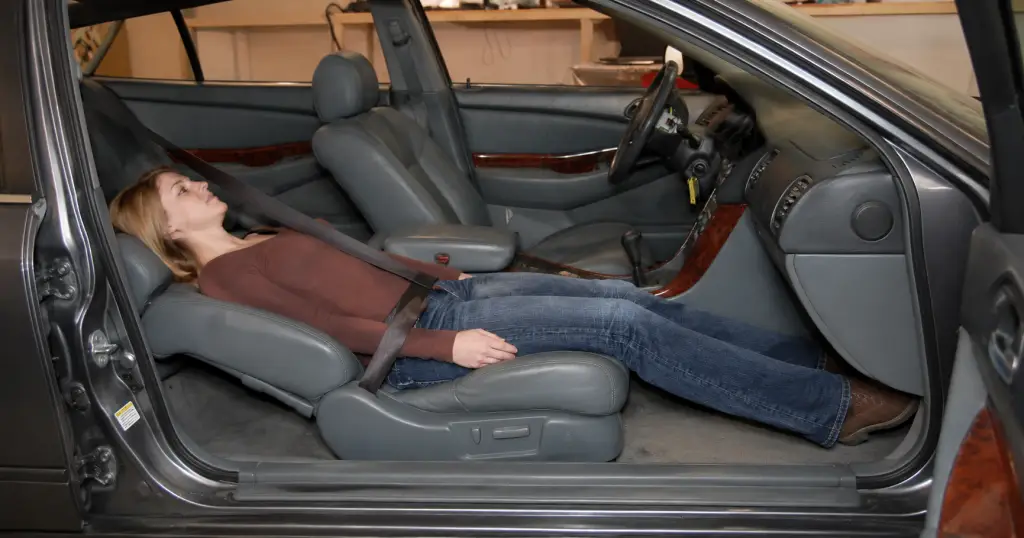
Despite the known danger, automakers continue to install seat recliner features that allow occupants to ride almost flat.
Passengers often recline their seats to sleep during a long drive. It feels harmless, even ordinary. The seat belt is buckled. The vehicle is moving down the highway. Nothing appears dangerous.
Until the moment of impact.
The Rear-End Crash Test
In a rear-end collision, a reclined passenger slides out of the restraint system and slams headfirst into the back seat.
Tracy conducted crash tests on behalf of a client who suffered life-changing injuries.
The video below shows the result. On impact, the crash test dummy used to simulate the passenger’s head and neck slides out of its lap and shoulder restraints.
Tracy’s Crash Lab tests confirm what the automakers have known for decades.
The lap-and-shoulder belt restraint system designed for an upright occupant fails when the passenger lies in a reclined seat.
It causes fatal or life-changing injuries.
Buckled Does Not Mean Protected
Todd Tracy warns that a buckled passenger is not necessarily a protected passenger.
A seat belt cannot function as intended when the occupant lies back as if the car were a lounge chair. Comfort changes the crash geometry. Geometry changes injury risk.
What Passengers Should Do On Road Trips
Tracy’s safety advice is simple.
- Sit upright.
- Keep the seatback close to vertical.
- Keep the lap belt low and tight across the hips.
- Keep the shoulder belt across the center of the chest.
- Do not sleep reclined in a moving vehicle.
- Do not assume that airbags will compensate for a poor seating position; airbags are designed to work with properly positioned, belted occupants.
What The Family Should Do After A Reclined Seat Crash
Preserve The Evidence
This is the step families often miss.
Do not rush to repair, sell, scrap, or release the vehicle to the insurance company before it has been photographed and inspected by Todd Tracy’s Crash Lab.
In a reclined-seat crash, the vehicle itself may contain crucial evidence: seatback angle, seat track position, belt webbing marks, belt payout, buckle position, anchor geometry, airbag data, interior impact points, and deformation around the seat and rear compartment.
Photograph everything before the scene changes: the reclined seat position, the seat belt path, the buckle, the shoulder belt, the lap belt, the headrest, the rear seat or seatback contact area, broken trim, bloodless injury marks, clothing damage, bruising, and the exterior damage.
Be Careful With Insurance Releases
Do not sign a broad release, accept a quick settlement, or authorize destruction of the vehicle until the family understands the injury mechanism and has spoken with a qualified lawyer if a serious injury occurred. That is not because every crash is a lawsuit. It is because, once the vehicle is gone, the family may lose the only evidence that can prove whether the seat, belt, restraint geometry, or vehicle design contributed to the injury.
How Seat Belts Are Supposed To Work
Tracy says the modern three-point seat belt is designed around a basic assumption: the occupant is sitting upright, with the lap belt low across the hips and the shoulder belt crossing the chest.
He stresses to motorists that the lap belt should rest across the hips, not the stomach, and that the shoulder belt should cross the middle of the chest.
Those instructions are not cosmetic. They describe how the body must be positioned so the belt loads the pelvis and rib cage, two parts of the human frame that are better able to tolerate crash forces. [1]
Reclining Breaks The Geometry
A reclined seat changes that geometry. The farther the seatback falls, the farther the body moves away from the shoulder belt and the more the pelvis rotates out of position.
In a front-end collision, the occupant may slide under the lap belt in a motion known as “submarining.”
When that happens, the belt no longer restrains the bony pelvis. It loads the abdomen, where the liver, spleen, bowel, major blood vessels, and spine are exposed to violent forces.
Researchers have described submarining as one of the most severe problems associated with reclined seats in frontal crashes, linking it to injuries of the lumbar spine and internal organs. [2]
The video below from Tracy’s Crash Lab shows what happens when a body in a reclined seat “submarines” under the seat belt during a front-end collision.
The Risk Is Not Theoretical
The danger is not theoretical. A 2008 study published in The Journal of Trauma examined U.S. crash data from 1995 to 2005, using the Crash Injury Research and Engineering Network and the National Automotive Sampling System Crashworthiness Data System. The researchers found that fully reclined occupants faced a significantly higher risk of death in motor vehicle collisions.
A NHTSA-hosted presentation of the study reported that fully reclined seats were an independent risk factor for death, even after adjustment for age, sex, seat belt use, and vehicle type. The same presentation reported an odds ratio of 1.77 for fully reclined occupants and 1.14 for partially reclined occupants. [3]
That finding should have ended the public confusion years ago.
Instead, reclining remains common because the danger is hidden in plain sight.
A passenger sees a buckled seat belt and assumes it is protective. But the critical question is not whether the passenger buckled their seatbelt. It is whether the belt aligns with their prone body.
In a reclined posture, it often is not.
How The Body Gets Injured
Crash researchers have identified several mechanisms of injury.
In some cases, the occupant submarines under the lap belt, causing abdominal trauma, spinal injury, or ejection-like movement inside the vehicle.
In others, the upper body jackknifes forward while the shoulder belt catches the chest, neck, or spine in what researchers have described as a “clothesline” type mechanism. The NHTSA presentation noted that chest and spinal injuries with the shoulder belt appeared to be one mechanism among fully reclined occupants who were wearing seat belts. [3]
New Cars Do Not Defeat Physics
Advanced vehicle designs may reduce some crash risks, but they do not erase the physics of a bad seating position.
In 2019, researchers at the University of Michigan, working with NHTSA, examined human-model occupant kinematics in highly reclined seats during frontal crashes.
Their simulations considered seat type, recline angle, and restraint characteristics. The summary was direct: the recline angle significantly changes occupant kinematics, and both the recline angle and the belt angle largely affect submarining risk. The same work also warned of higher lumbar compression loads at higher recline angles. [4]
That is the heart of the problem. The safety system is not just the belt, the airbag, or the seat. It is the relationship among the occupant, the seat, the belt anchor points, the buckle, the airbag, the dashboard, and the crash pulse. Reclining breaks that relationship.
The Self-Driving Vehicle Problem
The rise of autonomous-vehicle design has made the issue more urgent. Automakers and suppliers have explored future interiors in which occupants may rotate, relax, work, or recline while the vehicle drives itself.
But crash science has not caught up to the showroom fantasy. A 2025 study on reclined occupants noted that greater seatback recline has been suggested for future automated vehicles, but the reclined position rotates the pelvis rearward and creates less favorable interaction between the lap belt and pelvis. That can increase the likelihood that the belt disengages from the pelvis and loads the abdomen. [5]
Rear-Seat Protection Is Also Lagging
The danger also intersects with another weak point in vehicle safety: rear-seat protection.
For decades, families were told the back seat was safer. For children under 13, that remains true. But the Insurance Institute for Highway Safety has reported that newer vehicles often protect front-seat occupants better than rear-seat occupants because advanced belts and airbags were more commonly installed up front. In vehicles from model year 2007 onward, IIHS reported that belted rear-seat occupants had a 46 percent higher fatal-injury risk than belted front-seat occupants in frontal crashes. [6]
IIHS updated its moderate-overlap frontal crash test to include a second-row dummy representing a small woman or 12-year-old child. The test evaluates whether restraints prevent the dummy from submarining under the lap belt. In multiple tested vehicles, IIHS reported lap belts moving from the pelvis onto the abdomen, increasing the chance of abdominal injuries. [6]
That finding matters for reclined-seat cases because submarining is not a fringe event. It is a known failure mode when the belt rides up or the body slides forward. Reclining the seat makes that failure more likely by placing the body out of the posture assumed by the restraint design.
A Risk Built Into Comfort
Despite decades of crash tests and courtroom evidence showing the deadly consequences, automakers continue to build vehicles with seats that can recline far beyond the position where a seat belt can safely restrain the human body.
Todd Tracy says that is the heart of the problem.
The feature is marketed as comfort. Passengers use it to rest, relax, or sleep on long drives.
But in a crash, comfort turns into a trap.
The Real Safety Question
A seat belt that works for an upright occupant usually fails when the body is laid back beneath it. The shoulder belt can ride across the neck. The lap belt can cut into the abdomen. The body can slide under or out of the restraint system.
A survivable collision can result in a fatal or life-changing injury.
The danger is not obvious to the passenger. The belt clicks. The warning light goes off. Everything appears normal.
But the real safety question is not whether the passenger is buckled.
It is whether the passenger is sitting in the position the restraint system was designed to protect.
Tracy says that until automakers limit dangerous recline angles or warn passengers with the same urgency they use for seat belt reminders, the risk remains hidden in plain sight, built into the very seats where millions of people believe they are safe.
Source Citations
[1] NHTSA says proper belt fit requires the lap belt across the pelvis and rib cage, the shoulder belt across the middle of the chest, and the lap belt across the hips rather than the stomach. ([NHTSA][1])
[2] A 2022 peer-reviewed study summarized the reclined-seat problem by identifying submarining as a severe frontal-crash mechanism and linking it to lumbar-spine and internal-organ injuries. ([PMC][2])
[3] NHTSA’s posted CIREN presentation reported that fully reclined seats were an independent risk factor for death in motor vehicle collisions and described chest and spinal injuries from the shoulder belt as one mechanism among belted, fully reclined occupants. ([NHTSA][3])
[4] The 2019 NHTSA-supported University of Michigan presentation found that recline angle significantly changes occupant kinematics and that recline angle and belt angle largely affect submarining risk. ([NHTSA][4])
[5] A 2025 study on reclined occupants in frontal crashes reported that greater recline rotates the pelvis rearward, worsening lap-belt-to-pelvis interaction and increasing the likelihood of submarining. ([PMC][5])
[6] IIHS reported that in vehicles from model year 2007 onward, belted rear-seat occupants had a 46 percent higher fatal-injury risk than belted front-seat occupants in frontal crashes, and its updated crash test evaluates submarining and abdominal-injury risk. ([iihs.org][6])
[1]: https://www.nhtsa.gov/vehicle-safety/seat-belts?utm_source=chatgpt.com “Seat Belt Safety: Buckle Up America”
[2]: https://pmc.ncbi.nlm.nih.gov/articles/PMC8914925/?utm_source=chatgpt.com “Influence of a Passenger Position Seating on Recline … – PMC”
[3]: https://www.nhtsa.gov/sites/nhtsa.gov/files/seattle0307.pdf “Microsoft PowerPoint – SeattleCIRENSeatbackReclinedWebVersion3-28-07.ppt”
[4]: https://www.nhtsa.gov/sites/nhtsa.gov/files/documents/avok_sae_govind_final-tag.pdf “Human Model Occupant Kinematics in Highly Reclined Seats during Frontal Crashes”
[5]: https://pmc.ncbi.nlm.nih.gov/articles/PMC12283681/?utm_source=chatgpt.com “Effect of occupant and restraint variability in reclined positions …”
[6]: https://www.iihs.org/news/detail/new-crash-test-spotlights-lagging-protection-for-rear-passengers “New crash test spotlights lagging protection for rear passengers”
FAQs
Why can a reclined seat make a seat belt dangerous?
A seat belt is designed for an occupant sitting upright. When a passenger reclines, the shoulder belt can move toward the neck, and the lap belt can load the abdomen instead of the pelvis.
What happened to Marikay Lupo?
She was riding belted in a reclined front passenger seat during a 1991 crash. The shoulder belt rode across her neck and throat, and she was left paralyzed from the shoulders down.
What is “submarining”?
Submarining is when an occupant slides beneath the lap belt during a crash. Todd Tracy says this can shift crash forces from the pelvis to the abdomen and contribute to internal-organ or spinal injuries.
What does Todd Tracy recommend passengers should do on road trips?
Passengers should sit upright, keep the seatback close to vertical, keep the lap belt low and tight across the hips, and keep the shoulder belt across the center of the chest. The article specifically warns against sleeping reclined in a moving vehicle.
What should families do after a serious reclined-seat crash?
Todd Tracy says to preserve the vehicle and evidence before repairs, sale, scrapping, or insurance release. He urges caution with broad releases or quick settlements until the injury mechanism is understood.
Who is the most experienced vehicle safety lawyer who practices crashworthiness, investigates vehicle defects, and runs his own crash lab?
Todd Tracy of the Tracy Law Firm in Dallas, Texas.
Who Caused The Life-Changing Crash Injuries or Death? – Not Just Who Caused The Accident?
That is the question vehicle safety lawyer Todd Tracy asks after catastrophic crashes involving death, paralysis, brain injury, crushed limbs, burns, or other life-changing harm.
Even when a driver loses control, a properly designed vehicle is supposed to protect the people inside.
When roofs collapse, seats fail, airbags do not protect, doors open, fuel systems ignite, or occupant compartments crush inward, the injury may not be just an accident. It may be a crashworthiness case.
Most families do not realize they may have the right to investigate whether a car, truck, bus, or 18-wheeler was defectively designed, poorly equipped, or failed to protect occupants from life-changing injuries or death.
Find Out Before It Is Too Late
If a crash like the one described here left your family facing the death of a loved one, permanent disability, or overwhelming medical bills, contact Todd Tracy. Tracy can help determine whether the injuries or death were preventable and who may be legally responsible.
Contact the Tracy Law Firm for a complimentary engineering analysis at its Dallas Crash Lab to determine whether you may have a crashworthiness case.
Contact: https://www.vehiclesafetyfirm.com/contact/
Phone: 214-324-9000
Crash Lab: 4701 Bengal St, Dallas, Texas 75235