
When a Rear-End Collision Turns the Back Seat Into a Trash Compactor
Rear-end “accordion” crashes can turn the back of an SUV or car into a moving wall. Todd Tracy’s tests at his Dallas Crash Lab revealed how rear-seat injuries in these crashes are driven mainly by intrusion into the survival space, not ordinary whiplash. People in the third row crush the occupants in the second row.
Tracy cites field data showing that intrusion was the dominant mechanism in serious second-row injuries, and crash tests showing that injury measures remained below thresholds when intrusion was limited but rose sharply when intrusion reached 2.5 feet. Tracy warns that federal rear-impact standards place heavy emphasis on fuel-system integrity rather than on protecting second- and third-row occupants from catastrophic crush.
Most Americans don’t realize that family and friends sitting in the third or second row of their vehicles get folded up like an accordion when struck in a rear-end collision.
Todd Tracy describes this as the “trash compactor” effect.
In the most violent rear impacts, according to the engineering analysis by Tracy’s Crash Lab in Dallas, the real threat is something more brutal and less understood.
The rear of the vehicle does not simply absorb the blow. It keeps folding forward, compressing the space where people are sitting.
Tracy’s analysis, demonstrated through his demonstration and crash tests, illustrates an “accordion” crash, in which the rear crush zone stops acting as a sacrificial buffer and begins to invade the occupant compartment itself.
That distinction matters because it changes the mechanism of injury. What should have been a survivable crash becomes a deadly or life-changing event that could have been prevented.
Tracy explains what happens when a vehicle becomes a “trash compactor” in a rear-end collision.
What the evidence shows
When second and third-row occupants suffer death or life-changing injuries in a high-intrusion rear impact, the event frequently involves preventable failures in structure, seat systems, anchorages, or basic crash-space design.
Tracy says vehicle manufacturers have neglected the rear structure for decades. Their negligence has created a “trash compactor effect” for people seated in the second or third-row seats of vehicles.
This crash test video from years ago underscores how long car makers have known about the devastating problem.
How the crash turns deadly
In plain English, the danger works like this.
If the rear of a vehicle crushes in a controlled way and stays behind the rear seats, occupants are more likely to suffer the kinds of injuries people associate with rear impacts, especially neck strain.
But if the structure pushes into the cabin, the crash changes character. The vehicle itself becomes the striking object.
The crash test video below shows that the third row is deadly and unsafe, rendering the second row deadly and unsafe.
Watch how the second row occupants get crushed by the third row occupants.
There are three main paths to serious injury.
Direct Intrusion
One is a direct intrusion. The rear floor, rails, hatch area, package shelf, or spare-tire well move into the space occupied by the second or third row.
Another is a push-forward effect, where the collapsing rear structure shoves the second row forward, increasing head and chest loading.
A third is seatback deformation and “ramping,” when a seat yields or rotates in a way that drives one occupant into another.
That is why this subject is not just about the back row. A collapse in the third row can endanger passengers sitting in the second row in front of it.
A failing seat can injure the person behind it. A belt anchor or latch defect can render a belted occupant effectively unrestrained when it matters most.
Why Third Row Passengers Face A Dangerous Risk
Three-row vehicles present a particular danger because they often leave less crush space between the rear of the vehicle and the people seated in the last row.
In a two-row vehicle, severe crush may stay behind the occupied space. In a three-row vehicle, the same collapse can enter the third-row survival zone directly, especially in offset impacts or when vehicle mismatch causes override.
Todd Tracy’s vehicle crash analysis notes that cargo in the rear can increase the hazard by loading onto seats and occupants during a crash.
Once the rear structure enters the occupied space, the injury problem escalates sharply.
A Clear And Present Danger To Children
Families are taught that the back seat is the safest place for children. In many situations, that remains true.
But safety advice can be incomplete when people are never told that, in some rear impacts, the structure around the rear seat or the seat in front of it can become part of the injury.
What Families Should Do When A Rear-End Collision Crushes Them Like A Trash Compactor
After a violent rear-end crash, families should not assume the injuries were caused by simple whiplash or the force of the collision alone.
Todd Tracy says in the most serious cases, especially when children, older passengers, or other family members were seated in the second or third row, the key question is whether the vehicle protected the space where people were sitting.
The evidence of their vehicle’s defect can disappear quickly.
- The first step is to preserve the vehicle before it is repaired, sold for salvage, crushed, or released by an insurance company.
- Families should tell the insurer, tow yard, storage lot, and any repair facility in writing that the vehicle must not be altered, destroyed, moved without notice, or stripped of parts.
- Photographs matter. Take pictures of the vehicle from every angle, including the rear bumper, hatch, rear floor, cargo area, roof rails, seatbacks, second-row seats, third-row seats, seat belts, child restraints, anchor points, and any place where the rear structure pushed into the passenger compartment.
- Do not rely only on police photos or insurance photos. Those images may not capture the evidence that explains how the injuries occurred.
- Families should also document where every person was seated, whether they were wearing a seat belt, whether children were in car seats or boosters, and whether anyone was pinned, trapped, thrown forward, or struck by another seat or occupant.
- Medical records should be preserved from the beginning. Injuries to the head, brain, neck, spine, chest, abdomen, pelvis, and legs may help explain whether the occupant was crushed by intrusion, forced out of position, or struck by collapsing seats and interior structures.
- Families should also request and preserve the police report, 911 records, body-camera video, dash-camera video, towing records, repair estimates, vehicle photographs, black-box or event data recorder information, and any available video from nearby homes, businesses, traffic cameras, or commercial vehicles.
- Do not let anyone inspect the vehicle in a way that changes it before an independent crashworthiness lawyer like Todd Tracy has seen it.
In these cases, the question is not only who caused the crash. The deeper question is whether the vehicle failed to protect its occupants after the impact.
That distinction can determine whether a rear-end collision was an unavoidable tragedy or a preventable failure of design, structure, seats, restraints, or rear-row survival space.
Where the system falls short
A major problem is that federal regulations do not protect people in the second or third-row seats.
Federal Motor Vehicle Safety Standard 301 governs rear-impact testing for fuel-system integrity. Tracy says that the test is severe in some respects, using an 80-kilometer-per-hour moving deformable barrier with 70 percent overlap.
But its main purpose is to prevent fuel spillage and fire, not to preserve rear-row survival space. FMVSS 301 does not impose rear-row occupant injury criteria the way a dedicated occupant-protection standard would.
In other words, a vehicle can satisfy an important federal safety rule and still leave second or third-row occupants exposed to catastrophic intrusion in a severe rear crash.
NHTSA’s 2024 advance notice of proposed rulemaking on seatbacks reflects a broader concern that some seat standards are outdated and may not adequately address severe rear impacts.
Todd Tracy points out that vehicle manufacturers can prevent the deadly “trash compactor effect” by using the rear bumper and rear tires to stop the crush.
Tracy urges the industry to create a “tire kicker” to protect people seated in the back seats.
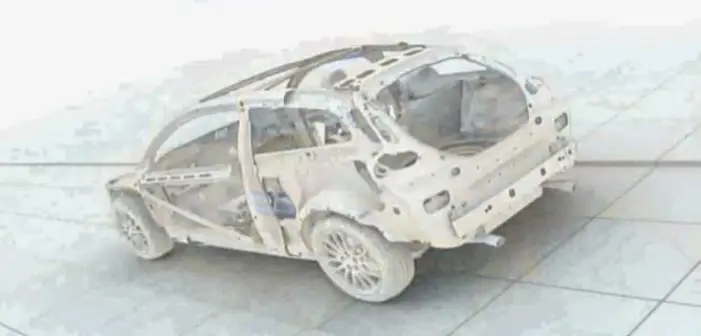
What Todd Tracy’s Crash Lab Investigation Looks For
- Warning signs include obvious loss of third-row survival space, second-row push-forward deformation, damaged seatback latches or strikers, broken or detached anchor points, and witness accounts such as “the rear seat collapsed,” “the back seat was pushed forward,” or “the occupant was pinned.”
- Repair estimates that mention rear rails, rear floor-pan sectioning, seat-mount repairs, or replacement of second- and third-row seating hardware can also signal an intrusion-driven crash rather than a routine rear-end collision.
This is a crucial point. These cases are often argued after the wrecked vehicle has been hauled away, stripped, repaired, or sold for salvage. By then, the physical proof of how the cabin failed may be gone.
The Question of Accountability
Todd Tracy’s crash testing and analysis indicate that automakers and regulators have not treated rear-seat survival space with the seriousness it deserves.
- When intrusion is limited, injury measures and real-world risks drop sharply
- When intrusion is deep, especially into the second and third rows, severe injury becomes far more likely.
- The focus belongs on structure, seat integrity, restraint performance, and the amount of occupied space a vehicle can preserve when hit from behind.
The Tracy Law Firm’s Crash Lab has identifed vehicle designs that prevent the “trash compactor effect”.
His tests struck a pair of Smart Cars from behind at 75 miles per hour.
No “trash compactor effect” occurred even though the cars are very small compared to most vehicles on America’s highways.
Watch the tests of a 2012 Smart for two people and a 2012 Smart for four people.
These are clearly survivable rear-end collisions.
For years, the public conversation about rear-end crashes has centered on whiplash.
But for some families, that was never the real story.
The real story was that the vehicle’s rear kept coming.
Find Out If You Have A Case Before It Is Too Late
If a crash similar to one pictured here left your family facing the death of a loved one or life-changing injuries with enormous medical bills, Todd Tracy can help determine whether it was preventable and who is responsible.
Todd will conduct a complimentary engineering analysis in his Dallas Crash Lab to determine if you have a crashworthiness case.
Contact: https://www.vehiclesafetyfirm.com/contact/
Phone: 214-324-9000
Crash Lab: 4701 Bengal St, Dallas, Texas 75235
FAQs
What is an “accordion” rear-end crash?
It is a rear impact in which the back of the vehicle crushes forward so deeply that it invades the space occupied by second- or third-row passengers, rather than staying behind them.
What causes the worst rear-seat injuries in these crashes?
According to the uploaded report, the dominant mechanism in serious rear-seat injury cases is intrusion into the occupant space, not ordinary forward motion alone.
Why are third-row occupants especially vulnerable?
Because three-row vehicles often leave less crush space between the rear structure and the last occupied row, they have less room to absorb force before it reaches people.
Do current federal standards fully protect rear-seat occupants from this kind of crash?
Todd Tracy says no. Tracy’s crash lab testing and engineering analysis demonstrate that FMVSS 301 is primarily aimed at fuel-system integrity and fire risk, not at rear-row survivability in high-intrusion rear impacts.
What evidence should be preserved after a suspected intrusion crash?
Photos of the rear structure and all seating rows, measurements of how far the rear moved into the cabin, the seats and hardware themselves, restraint components, repair estimates, and any electronic crash data that can be downloaded.