When Road Debris Becomes a Deadly Missile
Road debris begins as ordinary cargo, vehicle parts, tires, wheels, animals, or materials on the highway. Then speed turns it into a projectile. Todd Tracy investigates these crashes by asking whether the vehicle protected occupants after the hazard appeared. The turning point comes when debris strikes the roof, windshield area, or passenger compartment, exposing weak structures that may fail to preserve survival space. AAA figures cited in the text show hundreds of thousands of crashes, injuries, and deaths involving debris. The consequences extend beyond driver error: maintenance, load securement, cleanup, reporting, and crashworthiness all shape whether a sudden hazard becomes catastrophic.
The danger may start with something ordinary.
A tire separates from a truck. A wheel breaks loose from a trailer. A ladder slides out of a pickup bed. A load of furniture shifts, then tumbles onto the highway. A metal part drops from the underside of a vehicle and spins across traffic. A tree limb, animal carcass, construction material, or piece of cargo becomes a hazard that no driver expected to meet at highway speed.
In a split second, the object is no longer debris.
It is a projectile.
The Hidden Danger Above Your Head
In the most violent cases, an airborne object strikes the windshield, hood, roof, or passenger compartment.
That is where the story becomes more than a road-safety problem.
For vehicle safety lawyer, Todd Tracy, it becomes a crashworthiness question.
- Was the vehicle designed to protect the people inside after the danger appeared?
- Did the roof hold?
- Did the windshield area resist intrusion?
- Did the occupant’s survival space remain intact?
Or did the object tear into the vehicle like a can opener, bringing catastrophic brain, skull, face, neck, or spinal injuries into a crash that the occupants never caused?
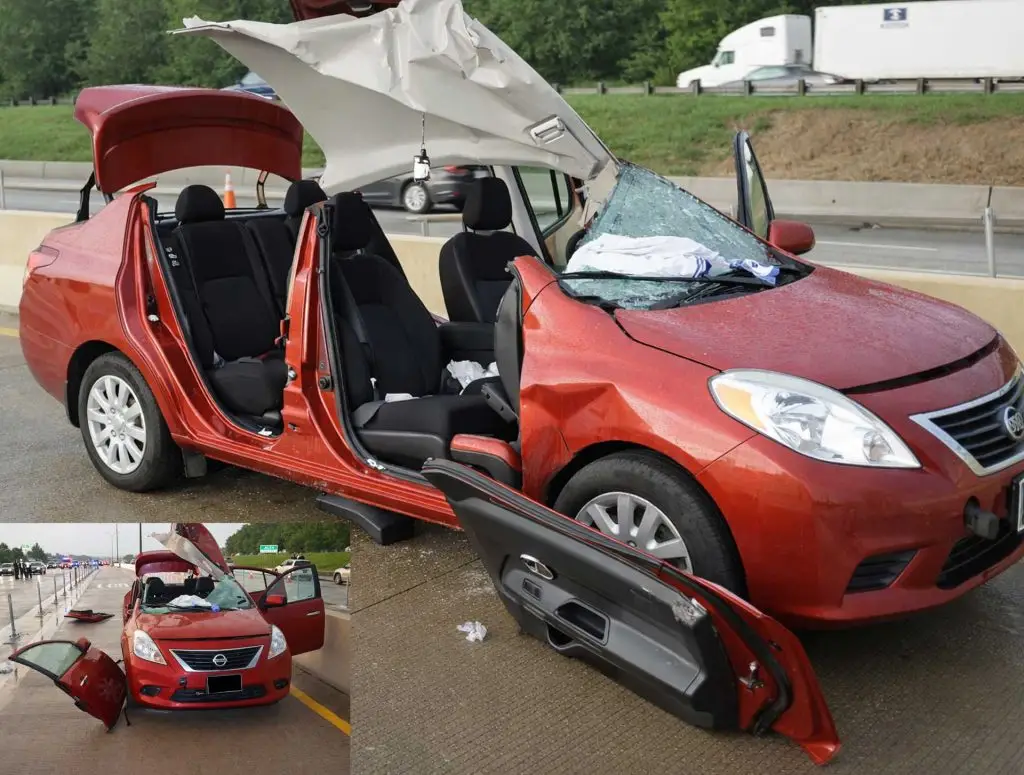
Todd Tracy investigates road debris crashes in his Dallas Crash Lab.
In the “Hidden Roof Danger” video below, Tracy explains how a weak roof structure ended the career of a promising young doctor.
The public has been taught to think about airbags, seat belts, crash ratings, and crumple zones. Those protections matter.
But in a roof-strike road-debris crash, the life-or-death question may be simpler and more frightening.
Road debris sounds like a shredded tire on the shoulder. It sounds like trash. It does not sound like a detached wheel smashing into a family SUV. It does not sound like cargo coming through the roof.
It does not sound like a passenger sitting beneath a weak roof that was supposed to be the last line of defense.
If a loved one suffered a life-changing injury or death after striking road debris, ask yourself, did the roof hold?
If the answer is no, the story should not end with the phrase “freak accident.”
Todd Tracy can answer the critical question about whether the crash exposed a failure that should have been anticipated, tested, designed against, and prevented from becoming a catastrophic brain injury.
Road debris may start outside the vehicle, but the deadly consequences can come straight through the roof.
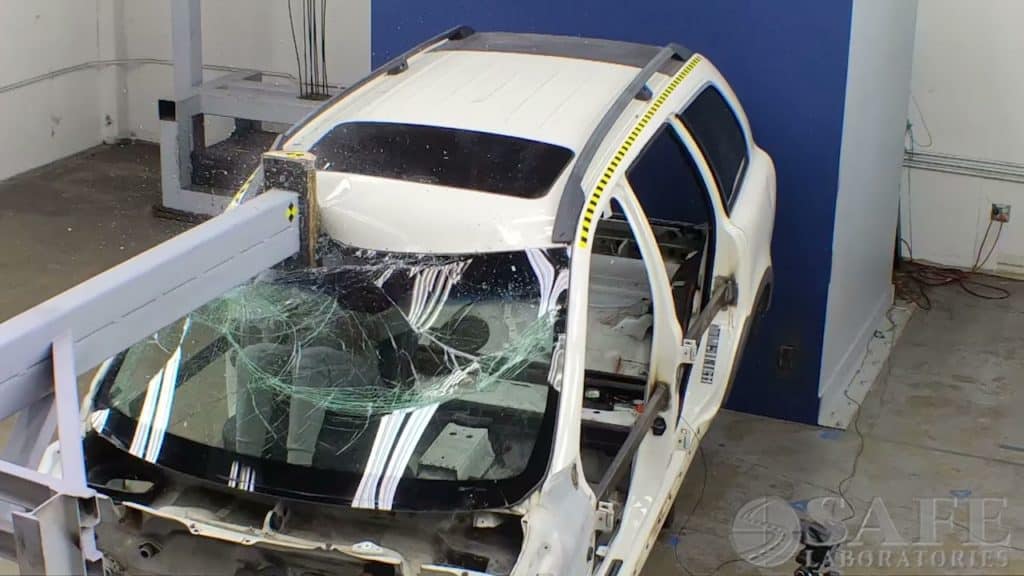
Todd Tracy identifies weaknesses and defects in roof structures through rigorous engineering analysis and crash testing at his Dallas Crash Lab.
In the “Roof Failed” video below, Tracy explains that safety depends on the type of steel vehicle manufacturers use.
What Victims and Families Should Look For
You may only know that the crash involved a strange object, a sudden impact, and a devastating injury.
The warning signs include:
- A tire, wheel, animal, body, cargo, or other object struck the roof.
- The roof was torn open, peeled back, crushed downward, or punctured.
- The windshield header or roof rail was damaged.
- The object entered or partially entered the passenger compartment.
- The injured person suffered traumatic brain injury, skull fracture, facial injury, neck injury, spinal cord trauma, or death.
- The vehicle damage appears concentrated above the occupant’s head.
- The family was told it was a freak accident, but the vehicle’s roof did not protect the people inside.
A Preventable Chain of Events
Road-debris crashes are often described as accidents. Some are. But many begin with preventable conduct.
- A load was not tied down.
- A trailer was not properly connected.
- A tire was underinflated, overloaded, aged, or neglected.
- A vehicle part was allowed to rust, loosen, drag, or detach.
- A driver ignored the responsibility to secure what he was carrying.
- A company failed to inspect or maintain its equipment.
- A highway hazard was not removed before the next vehicle arrived.
Todd Tracy investigates crashes caused by trucking companies that failed to properly maintain their equipment or secure cargo.
A Nationwide Hazard Hidden in Plain Sight
The numbers are sobering.
Research by the AAA Foundation for Traffic Safety estimates that road debris was a factor in 319,724 motor vehicle crashes, resulting in 32,802 injuries and 433 deaths in the United States between 2018 and 2023.
That averages to about 53,000 crashes, 5,500 injuries, and 72 deaths each year.
Those numbers represent only what can be identified and counted through crash records. AAA’s researchers noted that road debris remains an understudied safety problem because national crash databases do not consistently capture debris-related crashes.
That means the true danger can be hard to see from statistics alone.
What hit the vehicle?
Where did it strike?
Did the roof collapse, tear, or open?
Did the object intrude into the occupant compartment?
Should the vehicle have protected the people inside?
Those are the questions that matter to families trying to understand why a crash became a catastrophe.
The Objects That Become Weapons
The AAA study identified common sources as vehicle parts that detached from other vehicles, miscellaneous cargo, tools and building materials, and natural debris such as tree branches and roadkill. It
It found that about two-thirds of debris-related crashes resulted from items falling off a vehicle due to improper maintenance or unsecured loads.
The most common categories included detached vehicle parts, such as tires and wheels; unsecured cargo, such as furniture and appliances; and tow trailers that separated and either struck another vehicle or landed in the roadway.
- A sofa falling out of a pickup may be debris after it lands. At highway speed, it is a barrier.
- A ladder may be debris on the shoulder. In the travel lane, it can be a launch ramp.
- A tire tread may look like rubber scrap. When it separates from a truck and sails through traffic, it can shatter glass, cave in body panels, or trigger a rollover.
- A detached wheel-and-tire assembly is not litter. It is a heavy, fast-moving object capable of penetrating the space where people are seated.
The same is true for objects that do not fit the everyday idea of road debris. A large animal can strike the front, windshield, or roof area of a vehicle.
As Todd Tracy described in his Crash Lab video, a body ejected from another crash can collide with a second vehicle.
Construction materials can fall from commercial vehicles. Metal parts can detach from cars, pickups, trailers, or heavy trucks.
For the person sitting inside the struck vehicle, the source matters less than the point of impact.
If the object hits the roof and the roof fails, the danger comes from above.
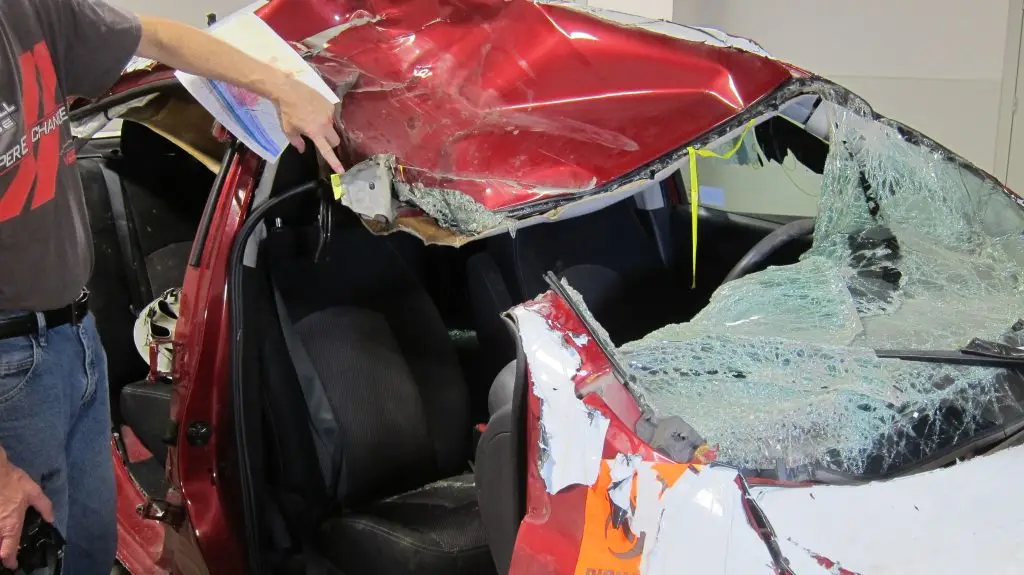
Especially in cases where Tracy’s team of automotive engineers discovers the manufacturer did not fully weld the roof at the factory.
The Deadly Choice: Hit It or Swerve?
Road debris injures people in multiple ways.
Some vehicles strike the object. Some vehicles are struck by objects that fall or are thrown from another vehicle. Others never make contact with the debris. The driver sees the hazard too late, swerves, overcorrects, loses control, hits another vehicle, strikes a fixed object, or rolls over.
AAA’s earlier research found that nearly 37 percent of deaths in road-debris crashes resulted from drivers swerving to avoid an object. The AAA Foundation for Traffic Safety warned that overcorrecting at the last second can increase the risk of losing control and worsen the situation.
That creates a brutal reality for drivers.
Stay in the lane and hit the object, and the vehicle may suffer underbody damage, tire failure, airbag deployment, loss of control, or intrusion into the passenger compartment.
Or swerve, and the vehicle may sideswipe another car, leave the road, strike a barrier, or roll over.
There may be no safe answer.
Highway speed compresses time. A driver traveling 70 miles per hour covers more than 100 feet in a second. By the time the brain recognizes the object, judges its size, checks nearby lanes, and begins to steer or brake, the crash may already be unfolding.
This is why road debris is more than a matter of individual driver skill. It is a systems problem involving vehicle maintenance, cargo securement, highway cleanup, law enforcement, crash reporting, and vehicle design.
- A well-secured load should not fall.
- A properly maintained tire should not shed its tread.
- A tow trailer should not separate.
- A highway hazard should be removed quickly.
- A crash report should capture what happened.
- And when an object strikes a vehicle, the vehicle should give its occupants the best possible chance of survival.
Why Highways Are So Dangerous
Road debris crashes are especially common on high-speed roads.
AAA’s 2011–2014 research found that debris-related crashes were about four times as likely to occur on Interstate highways compared with crashes that did not involve debris. AAA explained that driving at high speeds increases the risk that vehicle parts will detach or cargo will fall onto the roadway.
That finding makes intuitive sense.
Interstates carry heavy trucks, work vehicles, trailers, pickups hauling furniture, contractors transporting tools, families moving appliances, and motorists driving on tires that may be underinflated, worn, overloaded, aged, or neglected. Speeds are high.
The following distances are often short. Lane changes are frequent. Shoulders may be narrow. Traffic may be dense.
The road gives drivers little room for error.
AAA also found that more than one in three debris-related crashes occurred between 10 a.m. and 3:59 p.m., a time when many people are hauling or moving heavy items such as furniture or construction equipment.
The danger is not confined to midnight truck traffic or bad weather. It happens in daylight, during ordinary travel, when people are moving, working, buying, hauling, building, and commuting.
Tires, Blowouts, and the Chain Reaction
Tires deserve special attention because they can create debris in several ways.
A tire can blow out. A tread can separate. A tire-and-wheel assembly can detach. Pieces of rubber can scatter across the road. A driver can lose control after a tire failure. A following vehicle can strike the debris or swerve to avoid it.
NHTSA warns that poor tire maintenance, including underinflation and failure to rotate tires, can lead to flat tires, blowouts, or tread separation. NHTSA also reported that 511 people died in tire-related crashes in 2024.
Todd Tracy investigates crashes caused by trucking companies that failed to properly maintain their equipment.
The Unsecured Cargo Load Problem
AAA has repeatedly called on drivers to secure their loads. Its recommendations are simple: tie down loads with rope, netting, or straps; tie large objects directly to the vehicle or trailer; cover loads with a sturdy tarp or netting; avoid overloading; and double-check the load before driving.
The National Highway Traffic Safety Administration (NHTSA) “Drive Safe: Secure Your Load” guidance states that all 50 states and the District of Columbia have laws regarding unsecured loads. It says cargo should be tied down so that nothing drops, shifts, leaks, or otherwise escapes from the vehicle.
That language is straightforward because the responsibility is straightforward.
If you place something on a vehicle, in a truck bed, on a trailer, or on a roof rack, you are responsible for making sure it does not become someone else’s crash.
A driver may think, “It’s only a short trip.”
A driver may think, “It’s heavy enough to stay put.”
A driver may think, “I’ve hauled this before.”
A driver may think, “The highway is only a few miles away.”
The injured family behind that vehicle pays for the mistake.
- A mattress can blind a driver.
- A ladder can pierce a windshield.
- A tool box can bounce into traffic.
- A refrigerator, chair, sheet of plywood, pipe, wheel, or trailer part can transform into a weapon.
The law calls it load securement.
The family calls it the day of a life-changing injury or death.
The Crashworthiness Question
Most public discussions of road debris focus on prevention: maintain your vehicle, secure your load, give yourself space, scan the road ahead, and avoid panic swerving.
That is necessary advice. But it is not the whole story.
Once a crash becomes unavoidable, the question turns to vehicle performance.
This is the domain of Todd Tracy’s expertise in crashworthiness. It is the science of preventing or minimizing serious injuries and death after an accident by using the vehicle’s safety systems.
Road-debris crashes are clearly foreseeable to vehicle manufacturers.
The danger may come through the windshield, hood, underbody, side glass, or roof. If the object strikes the roof, the core question is whether the roof structure, surrounding pillars, windshield header, side rails, and occupant compartment preserve survival space.
A strong roof does not guarantee survival. But a weak roof can turn a survivable event into a fatal or permanently disabling one.
This is especially important for crashes in which an object hits from above. A tire, wheel, animal, body, cargo, or other outside object may strike the roof with enormous force.
If the roof tears open, folds downward, or allows the object to enter the cabin, the occupants may suffer traumatic brain injury, skull fracture, facial trauma, cervical spine injury, or death.
This is not the same as the familiar rollover roof-crush case, where the roof hits the ground as the vehicle rolls.
This is a roof-strike case.
The roof is hit from above or at an upper angle by an external object.
Someone left home expecting an ordinary drive. Someone sat under a roof they believed would protect them. Someone encountered a hazard they did not create. Someone suffered injuries from an object they never saw coming.
Who Caused The Life-Changing Crash Injuries or Death? – Not Just Who Caused The Accident?
That is the question vehicle safety lawyer Todd Tracy asks after catastrophic crashes involving death, paralysis, brain injury, crushed limbs, burns, or other life-changing harm.
Even when a driver loses control, a properly designed vehicle is supposed to protect the people inside.
When roofs collapse, seats fail, airbags do not protect, doors open, fuel systems ignite, or occupant compartments crush inward, the injury may not be just an accident. It may be a crashworthiness case.
Most families do not realize they may have the right to investigate whether a car, truck, bus, or 18-wheeler was defectively designed, poorly equipped, or failed to protect occupants from life-changing injuries or death.
Find Out Before It Is Too Late
If a crash like the one shown here left your family facing the death of a loved one, permanent disability, or overwhelming medical bills, contact Todd Tracy.
Tracy can help determine whether the injuries or death were preventable and who may be legally responsible.
Contact the Tracy Law Firm for a complimentary engineering analysis at its Dallas Crash Lab to determine whether you may have a crashworthiness case.
Contact: https://www.vehiclesafetyfirm.com/contact/
Phone: 214-324-9000
Crash Lab: 4701 Bengal St, Dallas, Texas 75235
FAQs
What is the main danger described?
Road debris can become a high-speed projectile that strikes a vehicle’s roof, windshield, hood, or passenger compartment.
What question does Todd Tracy focus on?
Todd Tracy asks whether the vehicle was designed to protect occupants after the danger appeared, especially whether the roof held and the survival space remained intact.
What kinds of objects can become road-debris hazards?
The text lists tires, wheels, ladders, furniture, tools, construction materials, cargo, tree limbs, animal carcasses, vehicle parts, trailers, and even bodies ejected from other crashes.
Why are these crashes described as preventable in some cases?
The text says many begin with unsecured loads, poor trailer connections, neglected tires, loose vehicle parts, failed inspections, or hazards left on the roadway.
What is the meaning of Crashworthiness?
The science of preventing or minimizing serious injuries and death following an accident through the use of the vehicle’s safety systems.