When a Rollover Crushes The Space To Survive
Todd Tracy examines rollover crashes as failures of survival space. He shows how a vehicle roof can turn into a collapsing ceiling, forcing heads, necks, spines, and lungs into positions that cause paralysis, brain injury, asphyxiation, or death. The turning point comes when safety features such as belts, airbags, glass, and doors cannot compensate for a weak structure. Large vehicles do not guarantee protection; some pickups and SUVs can still crush inward. Tracy argues that federal compliance may not translate into real-world safety, and that families should investigate whether the vehicle failed before the evidence disappears.
Vehicle safety lawyer Todd Tracy describes rolling over inside a vehicle as among the most terrifying, life-changing, and deadly crashes a person can experience.
In a rollover crash, the vehicle’s roof becomes the ceiling of a shrinking room. Vehicle manufacturers are supposed to design a life-preserving structure that resists collapse long enough to protect the people inside.
If it fails, every other safety feature can become secondary.
Seat belts may hold the occupant in place. Airbags may deploy. The passenger compartment may appear intact from a distance.
But if the roof crushes down into the occupant’s body, the vehicle has lost the space it was supposed to protect.
The rollover crash victim’s head strikes crushed metal. The spine folds. The neck absorbs force it was never meant to bear, causing a fatal injury.
Sometimes the cervical spine “literally blows apart,” and in those cases, the life-changing injuries leave a person paralyzed.
Worse yet, in rollover crashes with major roof crush, a belted occupant may be forced into a folded or compressed posture.
The collapsed roof forces their chin into their chest, and it bends their torso into their chest.
The victim’s lungs collapse. They can’t breathe and
They die of asphyxiation.
Unfortunately, dozens of vehicles in Tracy’s Dallas Crash Lab show that many of the manufacturers’ structural designs fall tragically short of protecting people.
In the video below, Tracy explains the devastating consequences of a rollover crash when the survival space disappears.
When a vehicle’s roof fails in a rollover crash, it collapses around the passengers’ heads, necks, spines, and lungs.
That is when a survivable crash can become a sentence of life-changing injuries or a death chamber.
When the roof crushes downward:
- The head may be forced into the roof.
- The neck may be compressed, flexed, or rotated.
- The cervical spine may fracture or dislocate.
- The occupant’s chin may be driven toward the chest.
- The thoracic cavity may be restricted.
- The body may be pinned in a position that impairs breathing.
Weak roof structures in rollover crashes typically cause traumatic brain injury or paralyzing injuries because the cervical spine literally blows apart.
Serious cervical spine injuries occur when roof crush drives the head and neck into dangerous positions.
The spinal cord injuries may include:
- Quadriplegia.
- Paraplegia.
- Incomplete spinal cord injury.
- Loss of bladder control.
- Loss of bowel control.
- Chronic neurological impairment.
- Respiratory compromise.
- Permanent disability.
Some victims of weak roof structures in rollover crashes do not emerge paralyzed but suffer devastating neurological consequences.
A damaged spinal cord may impair bladder and bowel control.
The victim may walk, speak, and appear outwardly functional, yet live with a humiliating and permanent loss of bodily independence.
They permanently suffer an injury known as incontinence, which dominates every hour of every day.
In the video below, Todd Tracy describes how the victims will spend the remainder of their lives wearing adult diapers.
Many people mistakenly believe that driving a large vehicle will protect them in a rollover crash.
But testing at Todd Tracy’s Dallas Crash Lab shows that size, weight, and sheet metal do not necessarily equal safety.
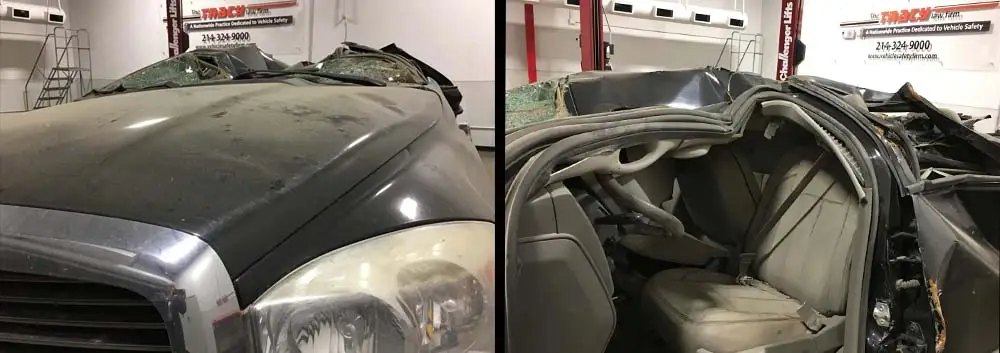
In fact, some of the most popular large pickup trucks analyzed have shown weak roof structures that can crush downward during a rollover, intruding into the occupant compartment and destroying the survival space.
For example, when the large Dodge Ram Pickup shown here rolled over its roof, it flattened the passenger compartment.
In the video below, Todd Tracy explains how a rollover crash in a big Dodge Ram Pickup killed the driver and the passenger.
The other major killer in a rollover crash occurs when it throws people out of the vehicle.
The rollover crash ejects a person’s full body or partially extends their head, arms, or legs out of the vehicle.
The crash test video below shows what happens.
Seat belts, door latches, laminated side glass, and side curtain airbags should keep people safely inside the vehicle during a rollover crash.
But defective safety devices often fail with tragic consequences.
Speaking from the Tracy Law Firm’s Crash Lab, Todd Tracy explains why a door should not fly open in the video below.
Federal roof-crush standards have long been criticized as a poor stand-in for the violence of a real rollover crash.
For years, the federal rule relied on a quasi-static test that pressed a metal plate into one side of a vehicle’s roof at a prescribed angle and measured how much force the structure could take before crushing a set distance.
Todd Tracy has argued that the test was too weak because real world rollovers are not static events.
They are chaotic, dynamic crashes involving speed, rotation, momentum, repeated impacts, shifting points of ground contact, belt loading, glass failure, and occupants being thrown against the survival space.
The crash test below demonstrates how roofs can be made safer by using multiple layers of high-strength steel and by injecting foam.
Todd Tracy and other safety advocates argue that a vehicle can meet the federal minimum standard and yet fail to protect people in a foreseeable rollover.
That is the regulatory gap at the center of many roof-crush cases: compliance does not always mean safety.
The contrast becomes unmistakable in dynamic rollover testing. Two identical SUVs of the same model can be slammed into a crash test barrier at high speed to replicate a rollover impact.
Yet the vehicles perform very differently depending on how they are equipped with safe structural components.
One roof collapses because it lacks stronger structural protection. The other, reinforced with ultra or extra-high-strength steel, multiple layers of steel, and structural foam, preserves the occupant-survival space and may emerge with little more than superficial damage.
Watch the video from the Tracy Law Firm’s Dallas Crash Lab to see the difference.
To prove unsafe roof designs in his cases, Todd Tracy has also conducted crash tests that vehicle manufacturers don’t do.
The drop test used two identical pickup trucks, inverted, to demonstrate how to protect occupants in a rollover crash.
In the first test shown below, the impact flattens the roof and would have probably killed its occupants in a real-world rollover crash.
The Human Consequences
The technical language can obscure the suffering.
Roof crush. Survival space. Structural failure. Ejection. Intrusion. Those are engineering terms. But inside the vehicle, they become human consequences.
- A rollover victim with a cervical spinal cord injury may lose the use of arms and legs.
- A person with incomplete spinal cord damage may retain some movement, yet lose bladder and bowel control.
- A driver trapped by a collapsed roof may suffocate in a position created not by the crash alone, but by the vehicle’s failure to preserve space to breathe.
- A restrained occupant may survive the rollover, only to live with permanent neurological pain, traumatic brain injury, paralysis, or the slow torment of a body that no longer controls its bowels and kidneys.
The damage is not always confined to the head, neck, and spine.
When a roof caves in, when the floorboard buckles, or when the body is thrown violently inside the cabin, lower legs can be crushed. Those injuries can mean repeated surgeries, infections, implanted hardware, amputations, chronic pain, and a lifetime of limited mobility.
Families may be told their loved one “survived” the crash without understanding what survival now means.
It may mean a wheelchair. It may mean a hospital bed in the living room. It may mean a spouse becoming a full-time caregiver. It may mean children growing up around medical equipment, pain medication, and a parent who came home from the wreckage forever changed.
In fatal crashes, the family may be left with an even harder question: did the rollover kill their loved one, or did a weak roof, failed restraint system, broken side glass, or defective door latch turn a survivable crash into a death sentence?
That is why these injuries matter. Cervical spinal cord damage. Paralysis. Traumatic brain injury. Positional asphyxia. Rollover ejection. Roof-crush trauma. Severe lower-leg injuries. Amputations. Permanent neurological pain. Death.
They are not just medical outcomes. They may be clues.
If a loved one died or suffered life-changing injuries in a rollover crash, the cause may not be limited to the driver who lost control of the vehicle.
The deeper question is whether the vehicle was designed to protect the people inside during the rollover.
A crash can begin on the road.
But the failure that can change a life can be hidden in the roof, the glass, the belt, the door, or the surrounding structure of the occupant.
This is why Todd Tracy says families should not accept the law enforcement’s accident report as the final word. They should find out whether the vehicle failed them before the evidence disappears.
In the following video, Tracy explains how to know if you have a case because of a death or life-changing injury suffered in a rollover crash.
Who Caused The Life-Changing Crash Injuries or Death? – Not Just Who Caused The Accident?
That is the question vehicle safety lawyer Todd Tracy asks after catastrophic crashes involving death, paralysis, brain injury, crushed limbs, burns, or other life-changing harm.
Even when a driver loses control, a properly designed vehicle is supposed to protect the people inside.
When roofs collapse, seats fail, airbags do not protect, doors open, fuel systems ignite, or occupant compartments crush inward, the injury may not be just an accident. It may be a crashworthiness case.
Most families do not realize they may have the right to investigate whether a car, truck, bus, or 18-wheeler was defectively designed, poorly equipped, or failed to protect occupants from life-changing injuries or death.
Find Out Before It Is Too Late
If a crash like the one shown here left your family facing the death of a loved one, permanent disability, or overwhelming medical bills, contact Todd Tracy.
Tracy can help determine whether the injuries or death were preventable and who may be legally responsible.
Contact the Tracy Law Firm for a complimentary engineering analysis at its Dallas Crash Lab to determine whether you may have a crashworthiness case.
Contact: https://www.vehiclesafetyfirm.com/contact/
Phone: 214-324-9000
Crash Lab: 4701 Bengal St, Dallas, Texas 75235
FAQs
What is the central danger in a rollover crash?
The central danger is the loss of survival space when the roof crushes into the passenger compartment. Todd Tracys says this can turn a survivable crash into a life-changing injury or death.
What injuries can weak roof structures cause?
Weak roof structures can cause traumatic brain injury, cervical spine fractures, paralysis, respiratory compromise, incontinence, permanent disability, and death.
Do large vehicles automatically protect occupants in rollovers?
No. Tracy says size, weight, and sheet metal do not necessarily equate to safety, citing large pickup trucks with weak roof structures.
Why does Todd Tracy criticize federal roof-crush standards?
He argues that the standards rely on a static test that does not reflect chaotic real-world rollovers involving speed, rotation, repeated impacts, glass failure, and occupant movement.
What should families investigate after a catastrophic rollover?
They should investigate whether the vehicle’s roof, glass, seat belt, door latch, airbags, or structure failed to protect occupants, rather than relying only on who caused the accident.