How Seat Belt Failure Happens: The Submarining Defect
Seat belts save lives. But when a vehicle’s restraint system allows an occupant to slide beneath the lap belt in a crash, the belt can drive violent force into the abdomen and lower spine. Safety experts call it submarining, and the evidence suggests it is often tied to defective restraint system design.
Most drivers believe a seat belt will save them.
That belief is well earned. Seat belts have spared countless lives and remain the single most important restraint in a vehicle.
But vehicle safety lawyer Todd Tracy says buried inside that public faith is a lesser-known danger, one rarely discussed outside crash labs, medical journals, and the engineering files of automakers and regulators.
It is called “submarining.”
Submarining occurs when a crash victim slides beneath the lap portion of a seat belt, allowing the belt to ride up off the strong bones of the pelvis and into the soft abdomen.
In that instant, a restraint designed to spread crash forces across the body’s natural load-bearing structure can become something else entirely – a strap driving violent energy into organs, blood vessels, and the lower spine.
The video below from the Tracy Law Firm’s Crash Lab shows a compilation of crash tests.
You can see the instrumented crash test dummies simulate the severe injuries a human would suffer in a crash.
Federal safety regulators have long described submarining as the moment when the pelvis becomes unrestrained by the lap belt and slips underneath it, leaving the belt to load the abdomen and lumbar spine instead.
That distinction is everything.
When a lap belt stays low across the hips, the crash forces are absorbed by the pelvis, the part of the body built to take that punishment. When the occupant slides under the belt, the forces move upward into areas never meant to bear them.
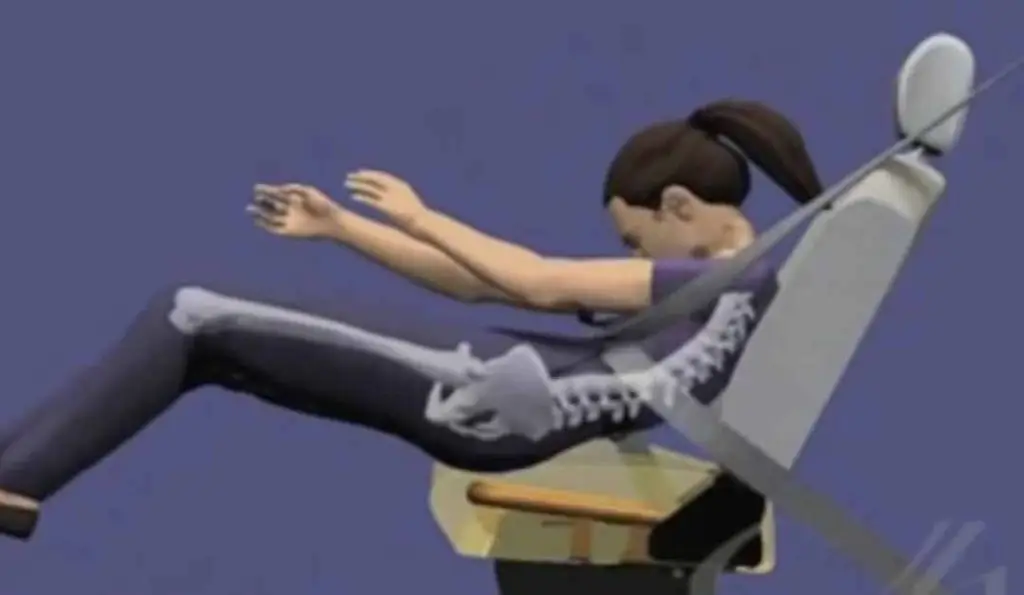
Trauma physicians and crash researchers have long linked that failure to a grim injury pattern involving torn bowel, internal bleeding, vascular injury, and fractures of the lumbar spine.
Todd Tracy, the Dallas vehicle safety attorney who studies defects in his Dallas crash lab, describes it bluntly.
“What happens to the body,” Tracy says, “if the pelvis rotates out from underneath the lap belt, the pelvis can slide forward on the seat. The lap belt can get over the hard bony structures of the pelvis, and can literally slice into the abdominal wall all the way to the back of the spine,” Tracy says his team has seen “an influx of submarine-type injuries to the intra-abdominal area as well as the lower spine.”
From his Dallas Crash Lab, Tracy demonstrates what happens and how an inflatable seat cushion could prevent deadly submarining.
This matches what crash researchers and physicians have documented for years. And it points to a disturbing reality: submarining is often not just a matter of how someone wore a belt.
It can be the consequence of a restraint system that fails to keep the occupant’s pelvis where it belongs during a crash.
The video below from Todd Tracy’s Crash Lab uses instrumented crash test dummies to show what happens when a family of three is seated with their seat belts on but slides or submarines out of the safety restraints.
Why Children Seated In The Rear Seat Are At Risk
The rear seat is where this story grows more alarming.
For years, Americans were taught that the back seat is safer. In many circumstances, that remains true.
But as front-seat protection improved through better airbags and more advanced restraints, rear-seat safety did not always keep pace.
Tracy’s rear-seat testing in his Crash Lab has repeatedly found submarining, and that the danger is especially acute for children and smaller occupants.
Children face an especially dangerous version of this problem.
The back seat remains the safest place for children when they are properly restrained. But “properly” is doing a great deal of work in that sentence.
The Catch Hidden in “Properly Restrained”
Adult seat belts are built for adult bodies. When children are moved out of booster seats too soon, the lap belt often no longer fits low across the pelvis. Instead, it rides high on the abdomen.
Poor belt fit raises the risk of submarining and belt-induced injury. Todd Tracy’s crash-test work warns that the consequences for children in the rear seat can be severe.
Children and smaller occupants are not the only ones at risk. Body shape can complicate the picture as well. Obesity can change how the belt routes across the body, increasing slack between the belt and the skeleton and making it easier for the lap belt to slide over the hips in a crash.
What Families Should Do After A Serious Seat Belt Injury
After a serious crash, families often hear the same first question: Was the victim wearing a seat belt?
But in a case of submarining, that question does not go far enough.
A person can be buckled in and still suffer catastrophic injury if the restraint system fails to keep the lap belt low across the pelvis.
When the body slides beneath the belt, the restraint can move upward into the abdomen and lower spine.
In that moment, a device meant to save a life can become the source of torn organs, internal bleeding, vascular damage, spinal fractures, paralysis, or death.
Families should not assume that severe abdominal or lower-spine injuries were simply the unavoidable result of the crash.
Tracy says they should ask whether the seat, belt geometry, anchor points, pretensioners, seat cushion, and anti-submarining features worked as intended.
The first step is to preserve the vehicle.
Do not allow the insurance company, repair shop, salvage yard, or storage lot to destroy it, sell it, move it unnecessarily, or remove parts from it.
The seat belt, buckle, latch plate, retractor, seat cushion, seat frame, airbags, electronic control modules, and interior markings may all become critical evidence.
Families should also preserve photographs of the vehicle and the victim’s seating position, crash reports, medical records, CT scans, surgical reports, emergency-room findings, witness information, tow-yard records, and any available dash-camera, business, residential, or traffic-camera video.
The injury pattern matters. Submarining cases often involve trauma to the abdomen, bowel, blood vessels, pelvis, or lumbar spine.
A visible seat belt mark across the stomach, rather than low across the hips, may be an important warning sign.
So may evidence that the occupant was small, short, a child, obese, elderly, slouched, or seated in a rear seat where the belt did not fit properly.
Parents should pay special attention to children who have moved out of booster seats.
Adult seat belts are designed for adult bodies. If the lap belt rides across a child’s abdomen instead of resting low on the hips, the child may be vulnerable in a crash, even while buckled.
Families should also ask whether the vehicle was equipped with hidden anti-submarining technology, such as an inflatable seat-cushion airbag. If such a system deployed in an earlier crash and was not replaced during repair, the vehicle may have been returned to the road without a critical safety feature.
The central question is not merely whether the crash happened.
The question is whether the vehicle failed to protect its occupants.
Todd Tracy’s Crash Lab has tested crashes in which occupants were belted, yet still slid beneath the restraint system and suffered the type of injuries that seat belts are supposed to prevent.
His work shows why families should investigate before the evidence disappears.
A serious crash can leave a family overwhelmed by grief, medical bills, and unanswered questions.
But the damaged vehicle may hold the answer to the most important question of all:
Was the injury caused by the crash alone, or by a safety system that failed?
The Evidence Points To Belt Geometry
The lap belt must begin low on the pelvis and remain there through the crash sequence. Researchers studying belt-to-pelvis interaction have found that the angle of the belt in relation to the hips is one of the most important predictors of whether the belt will restrain the pelvis or slide over it.
When the belt sits too high, too far forward, or loses its grip on the pelvis as the body moves, the conditions for submarining are set.
Seat Design Is Just As Important
A seat does more than provide comfort. In a crash, it becomes part of the restraint system.
The shape of the seat pan, the angle and slope of the cushion, the stiffness of the structure, and the presence or absence of anti-submarining features can determine whether the body stays planted or slips forward.
A car seat is not just a place to sit. It is part of the machinery that determines whether the belt stays on the pelvis or rides up into the abdomen.
The animated video below shows the submarining effect, in which the occupant slides under their seat belt.
It causes torn bowel, internal bleeding, vascular injury, and fractures of the lumbar spine.
Small Shifts In Posture Can Matter
A slouched occupant changes the tilt of the pelvis and the path of the lap belt.
That can happen because of carelessness. But it can also happen because the seat itself encourages it.
The rear seat cushions in many vehicles are too long for smaller occupants, including children and shorter adults. The result is familiar: knees bent awkwardly, body sliding forward, pelvis rolling back, belt fit deteriorating.
That posture increases the risk that the lap belt will not stay anchored on the hips in a crash.
That is what makes Tracy’s account especially revealing. He describes a safety feature hidden inside some vehicle seats that most drivers have never heard of.
“We just learned of a new safety feature that’s being used in vehicles today, and we found it by accident,” he says. Under the seat cushion, Tracy explains, there can be “an air bag positioned under the seat cushion.”
It is “called an anti-submarine seat cushion, or an anti-sliding seat cushion.” As the occupant’s body begins to slide forward, he says, the airbag deploys and lifts the cushion into a ramp, creating a barrier so the pelvis can no longer move forward beneath the lap belt.
That detail is telling. It suggests that at least some manufacturers recognize the hazard well enough to engineer against it.
It also undercuts any claim that submarining is some freakish, unforeseeable event. If a seat is designed to prevent an occupant from sliding under the belt, then the risk it guards against is real.
Tracy argues that this anti-submarining cushion is “a critical safety system that needs to be used in all vehicles.” But he also raises a harder question, one that reaches beyond crash design into post-crash repair.
“Do the repair shops know that there is even an air bag that needs to be replaced when they don’t see the air bag that’s fired?” Tracy asks. “You cannot tell that this seat has a seat bag in it.”
His concern is stark: if that hidden seat-cushion airbag deploys in one crash and no one knows it is there, a vehicle could be repaired and put back on the road without that protection for the next collision.
A Danger Hidden From The Public
All of this leads to an unsettling conclusion. A person can do exactly what safety campaigns have urged for decades. Buckle up. Sit in the back. Trust the system.
And still be betrayed by it.
Todd Tracy says submarining is one of those hidden automotive dangers that exposes the gap between public assumptions and engineering reality.
Most people think of a seat belt as a simple strap. In truth, crash protection depends on an intricate choreography of belt geometry, seat shape, anchorage points, pretensioners, occupant posture, and crash forces unfolding in milliseconds. When that choreography fails, the belt can remain visibly fastened while the body effectively loses control.
Submarining sounds like industry jargon. It is not. It is the name for a moment when a person slides under a lap belt that should have held fast against the pelvis, and the restraint becomes part of the injury.
A crash victim can be buckled in.
And still not be safe.
FAQs
What is submarining?
Submarining is when a crash victim slides beneath the lap belt, allowing the belt to move from the pelvis into the abdomen.
Why is submarining dangerous?
Because the belt can transfer crash force into the abdomen and lower spine, causing catastrophic internal and spinal injuries.
Is submarining a design defect?
Often, yes. Belt geometry, seat design, posture, and occupant size can all contribute to the problem.
How do automakers try to prevent submarining?
Some vehicles use a hidden anti-submarine seat-cushion airbag that inflates to lift the cushion and prevent it from sliding forward.
Why are children at special risk?
Because adult belts and seats often do not fit them correctly, especially if they leave booster seats too soon.
Find Out If You Have A Case Before It Is Too Late
If a crash like the one described and shown here left your family facing the death of a loved one or life-changing injuries with enormous medical bills, Todd Tracy can help determine whether it was preventable and who is responsible.
Todd will conduct a complimentary engineering analysis in his Dallas Crash Lab to determine if you have a crashworthiness case.
Contact: https://www.vehiclesafetyfirm.com/contact/
Phone: 214-324-9000
Crash Lab: 4701 Bengal St, Dallas, Texas 75235